
Keep our news free from ads and paywalls by making a donation to support our work!

Notes from Poland is run by a small editorial team and is published by an independent, non-profit foundation that is funded through donations from our readers. We cannot do what we do without your support.
The level of the Baltic Sea has this month fallen to its lowest level on record, reports the Institute of Oceanography at the Polish Academy of Sciences (PAN).
“In the first weeks of February 2026, the Baltic Sea experienced an unprecedented drop in water levels – average levels are now nearly 67cm below the norm, [which is] the lowest reading since systematic observations began in 1886,” wrote the institute on social media.
The low level means that the Baltic is currently “missing” around 275 km³, or almost 275 billion tonnes, of water, they added. However, the sea is not “drying up”. Instead, sustained easterly winds have pushed water through the Danish straits into the North Sea
“Over the last month or so, we’ve had a very intensive, persistent high-pressure system,” Tomasz Kijewski of the Institute of Oceanology told broadcaster TVN. “That pressure has exerted such force on the water that it’s been pumped out to the North Sea.”
The shallow water has a negative impact on navigation and sailing, limiting approach channels to ports, the institute notes.
However, it is also likely to have positive ecological consequences, as the deep waters of the Baltic are often deprived of oxygen. When the wind drops, the inflow of cold, salty and oxygenated North Sea water could “refresh” the basin, “like a deep breath for the ecosystem”, says the institute.
The Baltic Sea, the world’s largest brackish water basin, has very little natural outflow and inflow from land compared to wind and pressure.
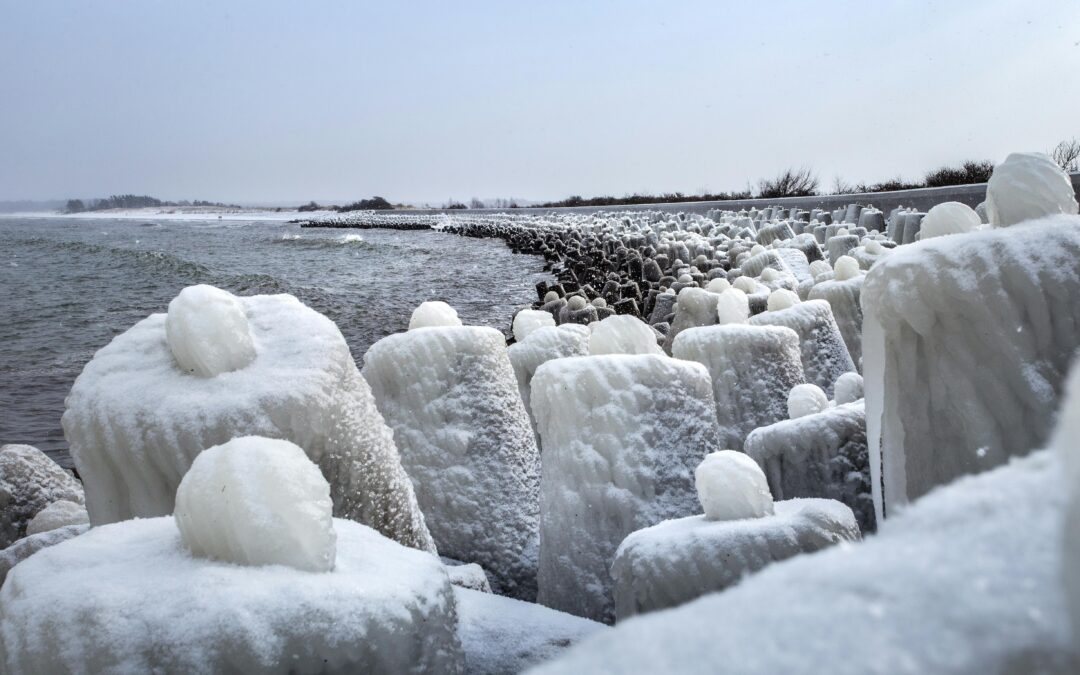
The untypically low water levels and cold weather that the region has been experiencing this winter has led to parts of the Baltic freezing, as well as the Vistula Lagoon, which Poland shares with the Kaliningrad exclave of Russia.
Poland has been experiencing a cold, snowy and icy winter, with January the coldest since 2010. In the Baltic port city of Gdańsk, the Motława River froze for the first time since 2011, leading many people to walk, skate and cycle on the ice, despite safety warnings from the local authorities.
Poland’s coastline on its northern border stretches for around 770 km (478 miles) along the Baltic Sea, with wide sandy beaches that are a popular attraction throughout the year. That is around one tenth of the inland sea, which is enclosed by another eight countries.
Many schools in northern Poland as well as in the capital Warsaw have closed due to cold temperatures, which fell well below -20°C (-4°F) in some places last night.
Meanwhile, the Motława River in Gdańsk has frozen for the first time since 2011 https://t.co/kgW4S9MfYj
— Notes from Poland 🇵🇱 (@notesfrompoland) February 2, 2026
Notes from Poland is run by a small editorial team and published by an independent, non-profit foundation that is funded through donations from our readers. We cannot do what we do without your support.
Main image credit: Marek Piwnicki/Pexels

Ben Koschalka is a translator, lecturer, and senior editor at Notes from Poland. Originally from Britain, he has lived in Kraków since 2005.