Keep our news free from ads and paywalls by making a donation to support our work!

Notes from Poland is run by a small editorial team and is published by an independent, non-profit foundation that is funded through donations from our readers. We cannot do what we do without your support.
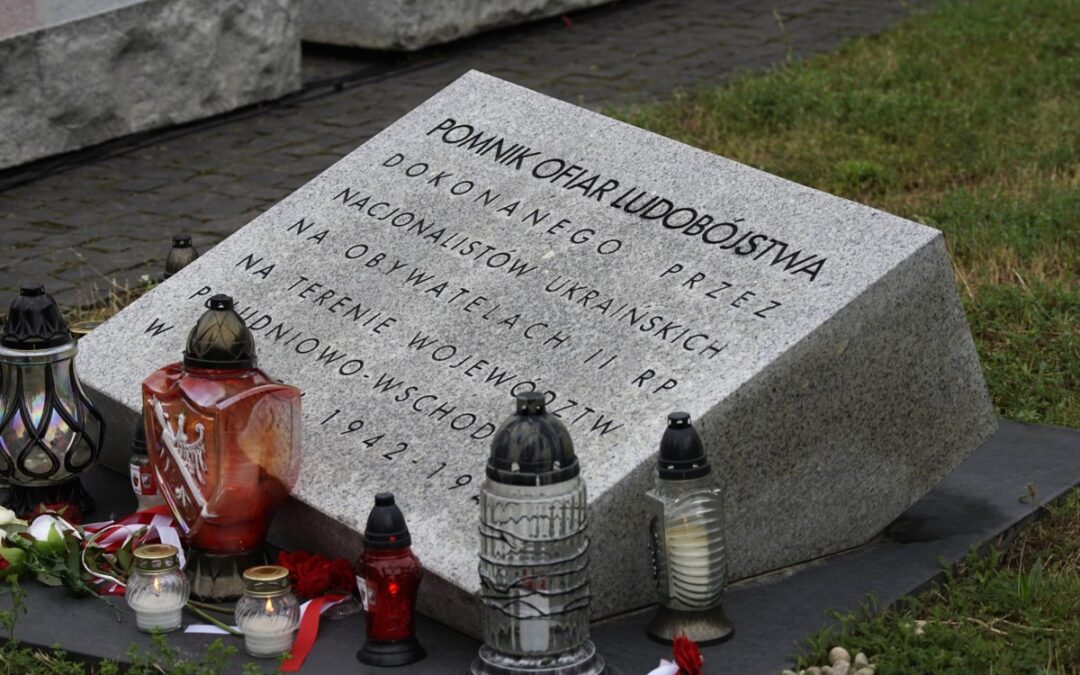
Poland’s state Institute of National Remembrance (IPN) has criticised the head of its Ukrainian counterpart after he called the Volhynia massacres, in which around 100,000 Poles were killed by Ukrainian nationalists, part of a “Polish grand narrative”.
He also said that they are viewed in Ukraine as a “local historical episode” and suggested they did not constitute a genocide, as Poland believes.
The clash marks the latest episode in a long-running dispute over how to assess the history of the massacres, which took place during World War Two. The issue has regularly caused tension between two otherwise close allies, though recent times have also seen progress towards reconciliation.
🟥 Zbrodnia Wołyńska nie jest „tragedią wołyńską”, ani tym bardziej opowieścią ani narracją – jest ludobójstwem dokonanym przez ukraińskich nacjonalistów ❗️
⚠️ W Polsce muszą oburzać słowa Ołeksandra Ałfiorowa – dyrektora Ukraińskiego Instytutu Pamięci Narodowej, który określa… pic.twitter.com/T7zaPB7CpU
— Instytut Pamięci Narodowej (@ipngovpl) February 10, 2026
On Tuesday, media outlet Ukrainska Pravda published a wide-ranging interview with Oleksandr Alfyorov, who was appointed as head of the Ukrainian Institute of National Remembrance (UINR) in June last year. One of the issues he spoke about extensively was the Volhynia massacres.
Asked if there was a chance for the issue to be removed from political debate and left to academics to discuss, Alferov said that this was “unfortunately unlikely” because “the Volhynia tragedy is one of Poland’s state myths”.
He then appeared to correct himself, saying it was “not a myth, but one of the key elements of the Polish grand narrative”.
By contrast, “for most Ukrainians, this is just a local episode of history, because it was only in Volhynia, and the Poles who left later settled throughout Poland”, explained Alferov. Volhynia is a historic region located in what is now northwestern Ukraine, southeastern Poland, and southwestern Belarus.
https://t.co/JfITn9OGPH
Szef Ukraińskiego Instytutu Pamięci Narodowej Ołeksandr Alferow, w najnowszym wywiadzie dla Ukrainskiej Pravdy mówi że Tragedia (?!) Wołyńska to część Polskiej Narracji. Twierdzi że demonizujemy Banderę i nie było żadnych rozkazów Szuchewycza 🤬— Ewa_S (@EwaS1993) February 10, 2026
During the Volhynia massacres, the Ukrainian Insurgent Army (UPA), a partisan formation still celebrated by many in today’s Ukraine, killed ethnic Poles in areas the UPA wanted to be part of a Ukrainian state.
The majority of victims were women and children, and the massacres were often carried out with particular brutality. Poland has officially recognised the episode as a genocide. However, Ukraine rejects that designation.
In his interview, Alferov pointed to historical research showing that “over 28,000 Ukrainians were also killed in this conflict [with Poles]”. He then asked: “Can the events be called genocide if there are victims on both sides?”
Later on Tuesday, Poland’s IPN, a state institution dedicated to documenting Poland’s history during World War Two and the postwar decades of Moscow-imposed communist rule, said that Alferov’s comments were “outrageous”.
“The Volhynia genocide is a documented fact that cannot be invalidated by the language of narrative, relativisation or political calculation,” wrote the IPN.
“The scale of the crime does not cease to be a crime simply because it occurred in a specific territory,” they continued. “Over 100,000 murdered Polish citizens – mostly women, children and the elderly – is not an ‘episode’, but rather one of the largest genocides against civilians in 20th-century Europe.”
The IPN also said that the fact that “the contemporary Ukrainian state builds elements of its identity on the cult of individuals and organisations responsible for these crimes, rejecting the facts recorded in publicly available historical sources, is also disturbing”.
Polish officials, including the prime minister, have condemned Ukraine's parliament for commemorating nationalist leader Stepan Bandera on his birth anniversary
Bandera is seen in Poland as responsible for the genocide of ethnic Poles and Jews during WWII https://t.co/YSRrDpTAIc
— Notes from Poland 🇵🇱 (@notesfrompoland) January 2, 2023
Recent years have seen moves towards reconciliation between Poland and Ukraine over World War Two history. In an important symbolic moment, the two countries’ then-presidents, Andrzej Duda and Volodymyr Zelensky, in 2023 jointly commemorated the 80th anniversary of the massacres.
Last year, Ukraine also lifted its ban on the exhumation of victims of the massacres, tens of thousands of whom are believed to remain buried in unmarked mass graves.
In his interview, Alferov said that he was “sure that, after the permission for the exhumation is granted, the topic will subside over time”. He said that Ukraine had “shown decency by granting permission” for the exhumations to take place.
However, in its response to his comments, the Polish IPN warned that “true reconciliation can only be based on truth”, including “the Ukrainian state unequivocally condemning the perpetrators of the Volhynia massacres”.
Polish victims of massacres committed by Ukrainian nationalists in WWII have been reburied in Ukraine at a ceremony attended by officials from both countries.
Their remains were exhumed this year following a diplomatic breakthrough between Kyiv and Warsaw https://t.co/FQwhjXOZDb
— Notes from Poland 🇵🇱 (@notesfrompoland) September 6, 2025
The dispute over the massacres is more than just symbolic. In 2024, a Polish deputy prime minister said that Poland would not allow Ukraine to be admitted to the European Union until the two countries “resolve” their differences over Volhynia.
That position was also expressed last year by the current president, Karol Nawrocki, when, while campaigning for the presidency, he said that he “currently does not envision Ukraine in either the EU or NATO until important civilisational issues for Poland are resolved”.
Last year, the Ukrainian government criticised Poland’s plans to establish a new national holiday commemorating victims of the massacres, saying that the idea “flies in the face of the spirit of good neighbourly relations”.
Ukraine has criticised plans by Poland to create a "day of remembrance for Polish victims of the genocide" carried out by Ukrainian nationalists during WWII.
Kyiv says the idea “flies in the face of the spirit of good neighbourly relations” https://t.co/zkdebpw1G4
— Notes from Poland 🇵🇱 (@notesfrompoland) June 5, 2025
Notes from Poland is run by a small editorial team and published by an independent, non-profit foundation that is funded through donations from our readers. We cannot do what we do without your support.
Main image credit: UdSKiOR (under CC BY-SA 4.0)

Daniel Tilles is editor-in-chief of Notes from Poland. He has written on Polish affairs for a wide range of publications, including Foreign Policy, POLITICO Europe, EUobserver and Dziennik Gazeta Prawna.