Keep our news free from ads and paywalls by making a donation to support our work!

Notes from Poland is run by a small editorial team and is published by an independent, non-profit foundation that is funded through donations from our readers. We cannot do what we do without your support.
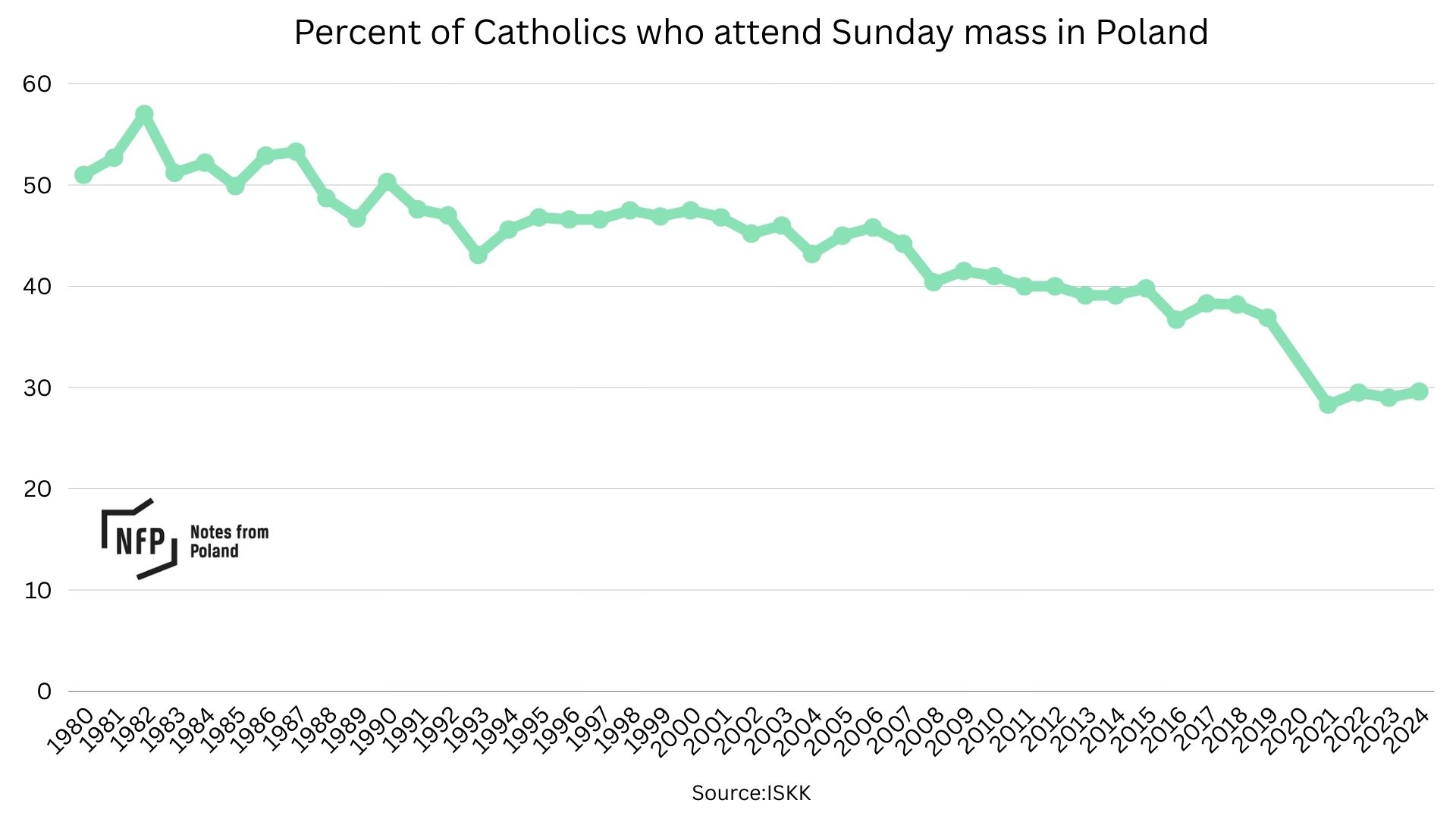
The proportion of Catholics who attend Sunday mass has now stabilised at around 30% after previously falling from a peak of 57%, new data from the church’s statistics institute show.
Meanwhile, the proportion of children taking optional Catholic catechism classes in schools has continued to fall, though a large majority, around three quarters of pupils, continue to attend.
Since 1980, the Catholic church in Poland has conducted an annual study of how many people attend mass and take communion. On one Sunday each year, every parish in the country records figures and submits them to the Institute for Catholic Church Statistics (ISKK).
The ISKK then calculates nationally what proportion of Catholics who are required to attend mass – meaning people aged over seven and excluding the bedridden and elderly with limited mobility – actually did so on that day.
The latest figures show that, in 2024, 29.6% attended mass. That was a similar level to 2023 (29%) and 2022 (29.5%). Previously, there had been a long-term decline in attendance, from a peak of 57% in 1982 to a low of 28.3% in 2021 (during the Covid pandemic).
The director of ISKK, Marcin Jewdokimow, said that the new data “confirm the trend…[that] religious practices are stabilising” and the earlier “decline…has stopped”.
The stabilisation of recent years does not necessarily mean, however, that actual attendance numbers are not continuing to fall. The ISKK’s figures show the proportion of Catholics who attend mass, but recent years have seen the number of Catholics in Poland decline as growing numbers leave the church.
The most recent national census, conducted in 2021, found that 71% of Poles identified as Catholics, down from 88% a decade earlier.
The new ISKK figures also show that church attendance continued to be much higher in the conservative east and south of the country than in the more liberal west and north.
Among Poland’s 42 Catholic dioceses, the highest attendance was in the southeastern Tarnów (62.3%) and the lowest in northwestern Koszalin-Kołobrzeg (17.5%).
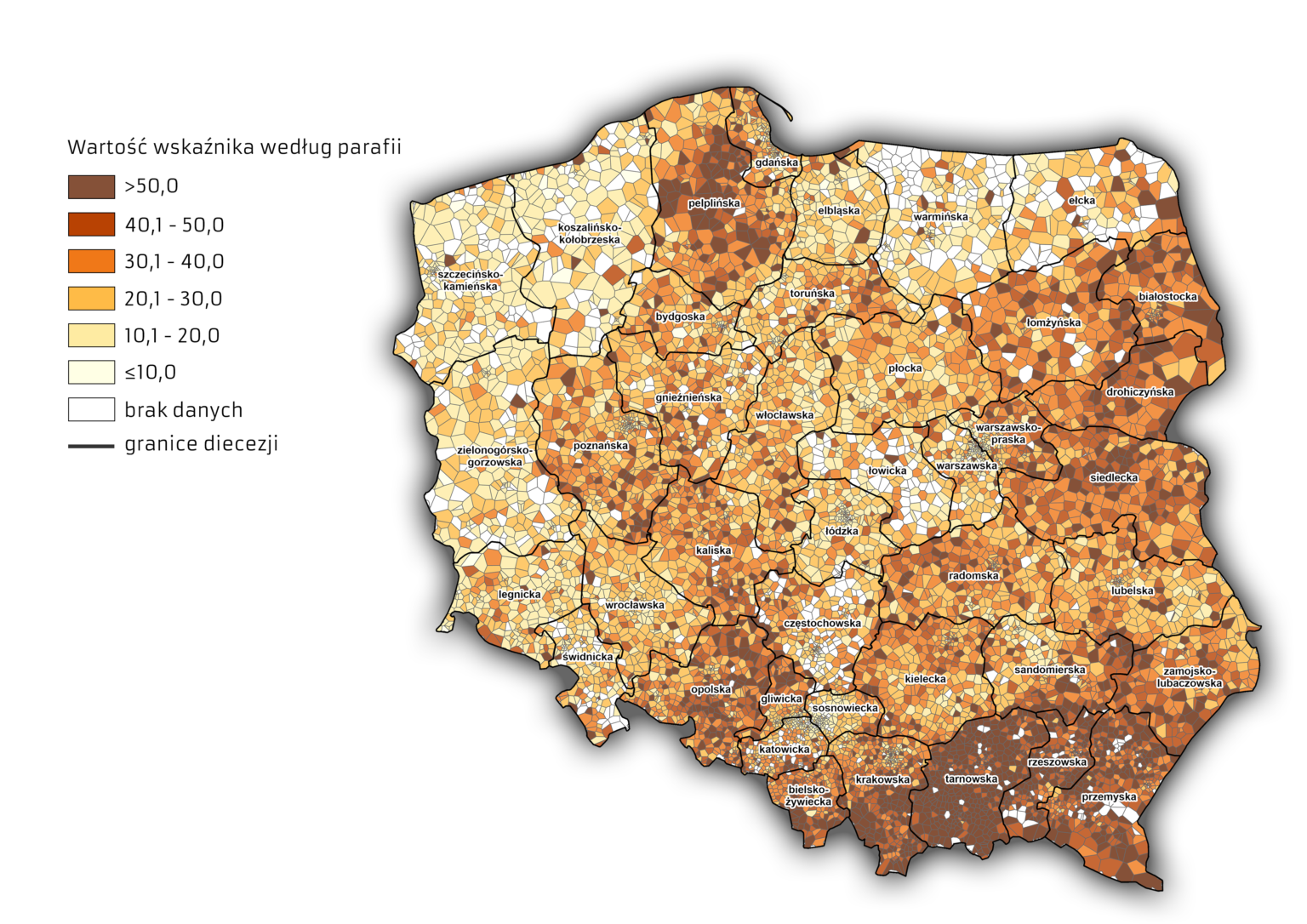
Percentage of Catholics attending Sunday mass in Poland’s parishes (source: ISKK)
In its report, the ISKK also records the proportion of pupils who attend optional religion classes. Though hosted by public schools, those classes have teachers and curriculums chosen by the church and are generally used to teach Catholic catechism.
In the 2024-25 school year, a large majority of children, 75.6%, attended the classes. That was down from 78.6% in the previous year and from 88% in 2018-19, when the ISKK began gathering such data.
The lowest level of attendance (59.1%) was in the Szczecin and Kamień archdiocese in northwestern Poland, while the highest figure (96.1%) was again found in Tarnów diocese.
The Polish government has enacted a regulation halving the number of state-funded religion classes in public schools to one hour per week.
The change, criticised by the Catholic church as "unlawful", will come into force on 1 September 2025https://t.co/jj8nHDgLHd
— Notes from Poland 🇵🇱 (@notesfrompoland) January 20, 2025
The teaching of religion in schools has become a growing area of controversy, in particular since the arrival of a more liberal government in 2023. It has halved the number of hours religion is taught and removed religion grades from end-of-year averages, prompting opposition from the church.
Meanwhile, in another sign of growing secularisation, the new ISKK data show that, in 2024, the proportion of marriages in Poland conducted with Catholic sacraments was close to falling below half. The figure stood at 50.4%, down from just over 70% a decade ago.
However, almost 87% of newborn children in Poland were baptised into the Catholic church in 2024, a figure that has fallen from over 93% a decade earlier.
While Poland remains one of Europe’s most religious countries, the Catholic church has faced a number of challenges in recent years, including criticism over negligence in dealing with child sexual abuse by members of the clergy and accusations that the episcopate had involved itself in politics.
Notes from Poland is run by a small editorial team and published by an independent, non-profit foundation that is funded through donations from our readers. We cannot do what we do without your support.
Main image credit: Archidiecezja Krakowska/Flickr (under public domain)

Daniel Tilles is editor-in-chief of Notes from Poland. He has written on Polish affairs for a wide range of publications, including Foreign Policy, POLITICO Europe, EUobserver and Dziennik Gazeta Prawna.