Keep our news free from ads and paywalls by making a donation to support our work!

Notes from Poland is run by a small editorial team and is published by an independent, non-profit foundation that is funded through donations from our readers. We cannot do what we do without your support.
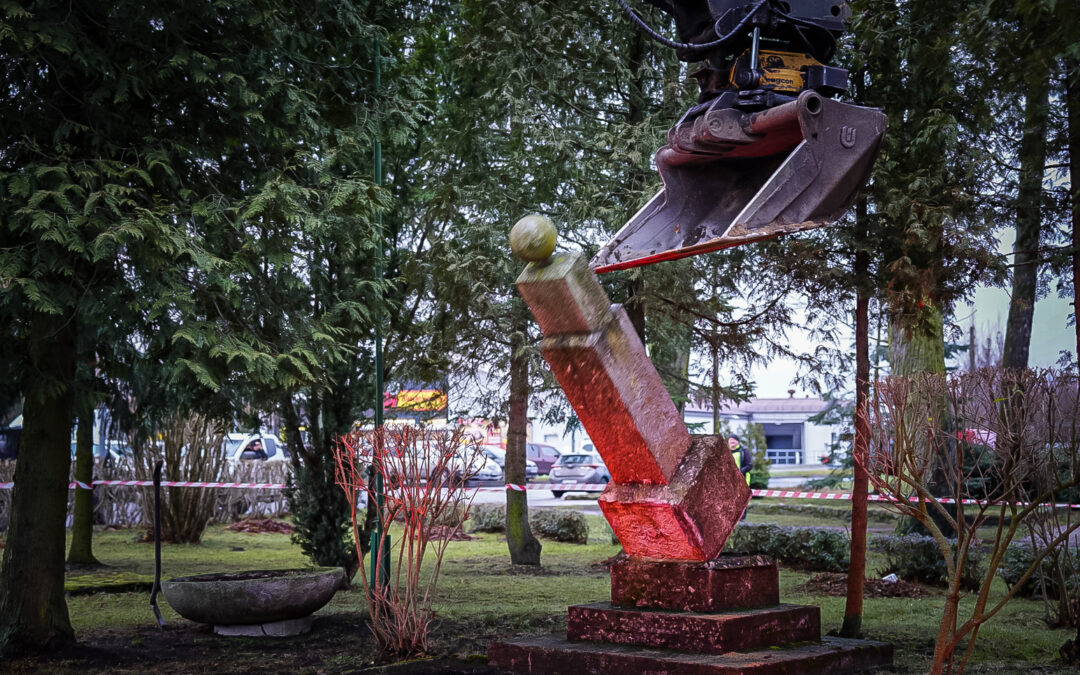
A monument to the Soviet “liberation” of Poland has been demolished in the small town of Maszewo – the latest in a long-running campaign to “decommunise” public spaces in Polish towns and cities.
“There is no place for Soviet objects in a free Poland,” declared Karol Polejowski, the deputy head of the state Institute of National Remembrance (IPN), which has led efforts to demolish dozens of communist-era monuments since Russia’s full-scale invasion of Ukraine.
“We say ‘no’ to…Russians who believe that these lands somehow belong to their sphere of influence,” he added, speaking at a ceremony to mark the destruction of the two-metre-high obelisk with an industrial digger.
🟥 Obiektom propagandowym mówimy nie!
➡️ 36 lat temu w Nowej Hucie, po protestach zorganizowanych przez Federację Młodzieży Walczącej, został zdemontowany pomnik Lenina. W rocznicę tego wydarzenia w Maszewie zdemontowaliśmy 44. obiekt sowieckiej propagandy.
💬 – Sowietom,… pic.twitter.com/2plh1ob1bc
— Instytut Pamięci Narodowej (@ipngovpl) December 10, 2025
The monument was erected in the immediate aftermath of World War Two, when the Red Army had swept through Poland, pushing out the German-Nazi occupiers but then bringing the country, along with the rest of the Soviet Bloc, under decades of Moscow-imposed communist rule.
“These were not liberators,” said Polejewski. “They did not bring freedom to Poland, and this object was intended to legitimise their rule in this area.”
The obelisk had originally stood outside Maszewo’s town hall, topped with a red star and bearing the inscription: “Glory to the liberators.” Later, after the fall of the communist regime, the star and plaque were removed. The monument was then moved to a square on the edge of town.
Now, however, it has been demolished completely. The town’s mayor, Paweł Piesio, told the Polish Press Agency (PAP) that many residents have called for its removal and, when he proposed it to the town council, there were no objections
A new memorial will be built in its place next year, commemorating residents of the town and surrounding areas who moved there after the war, when it was transferred from Germany to Poland.
In 2016, the then-ruling national-conservative Law and Justice (PiS) government introduced a law requiring local authorities to “decommunise” public spaces by removing objects and names that “propagate communism or other totalitarian systems”.
However, only in 2022, after Russia’s full-scale invasion of Ukraine, did efforts to remove Soviet-era memorials accelerate. The one now dismantled in Maszewo is the 43rd to be torn down in that period.
Those efforts were previously led by Karol Nawrocki, who headed the IPN from 2021 until this year, when he was elected president of Poland, taking office in August.
Polejowski noted that many Soviet-era monuments remain, including in various parts of the West Pomerania province where Maszewo is located. He appealed to local authorities to show “courage” and remove them.
Poland has removed another Soviet monument – the 41st since Russia's invasion of Ukraine.
Hundreds of local residents gathered to watch it being demolished, with many applauding as it collapsed https://t.co/KZ21qBfxMn
— Notes from Poland 🇵🇱 (@notesfrompoland) July 23, 2024
The removal of Soviet memorials in Poland has been criticised by Russia, which argues that not only does it dishonour the memory of those who liberated the country from Nazi-German occupation, but also violates a bilateral agreement between the two countries.
Poland has pointed out, however, that the agreement relates only to graves and war cemeteries, not separate monuments and symbols. It also notes that, while the Red Army did push out the German occupiers, its arrival ushered in decades of brutal communist dominance.
Notes from Poland is run by a small editorial team and published by an independent, non-profit foundation that is funded through donations from our readers. We cannot do what we do without your support.
Main image credit: Mateusz Niegowski/IPN (under CC BY-NC-ND 3.0 PL)

Daniel Tilles is editor-in-chief of Notes from Poland. He has written on Polish affairs for a wide range of publications, including Foreign Policy, POLITICO Europe, EUobserver and Dziennik Gazeta Prawna.