Keep our news free from ads and paywalls by making a donation to support our work!

Notes from Poland is run by a small editorial team and is published by an independent, non-profit foundation that is funded through donations from our readers. We cannot do what we do without your support.
A court in Warsaw has ruled that a former Auschwitz prisoner can seek financial compensation from a German publisher that used the term “Polish extermination camp” to describe a German-Nazi death camp in occupied Poland. However, it also found that he cannot request an apology for the error.
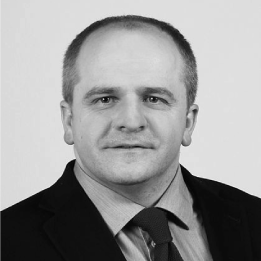
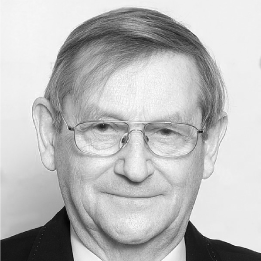
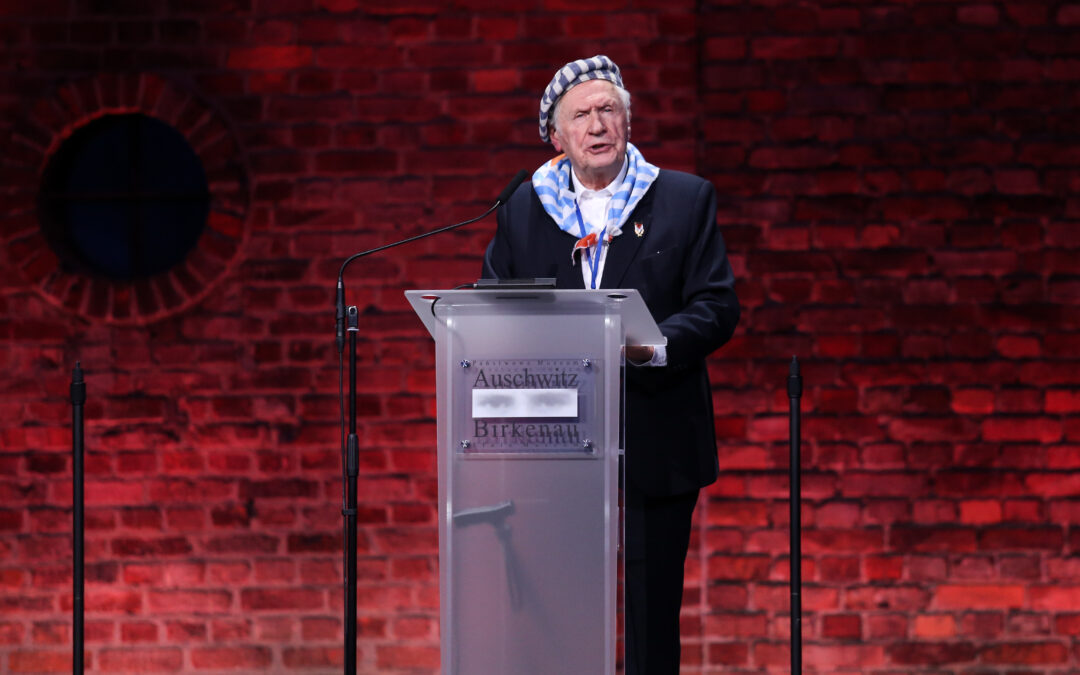
The ruling comes as part of a long-running legal battle fought by Stanisław Zalewski (pictured above), a former member of the Polish underground resistance who is president of the Polish Association of Former Political Prisoners of Nazi Prisons and Concentration Camps. He turned 100 in October.
Przed polskim sądem nie można żądać przeprosin za określenie „polskie obozy”, które pojawiło się na niemieckim portalu, ale można ubiegać się z tego tytułu o pieniężne zadośćuczynienie.https://t.co/PvKhqDhtHi
— Rzeczpospolita Prawo (@RPPrawo) November 28, 2025
The case originated in April 2017, when a German newspaper publisher, Mittelbayerischer Verlag KG, published an article about a Polish-Jewish Holocaust survivor whose sister, it said, was “murdered in the Polish extermination camp of Treblinka”.
International media often mistakenly refer to Nazi-German camps established in occupied Poland as “Polish”. The Polish authorities have long campaigned against such usage, as it suggests that Poland, rather than Germany, was responsible for establishing and running the camps.
In this case, Mittelbayerischer Verlag changed its article within a few hours following intervention by the Polish consulate in Munich. Its corrected text stated that the sister “was murdered by the Nazis in the German Nazi extermination camp of Treblinka in occupied Poland”.
However, seven months later, in November 2017, Zalewski filed a civic lawsuit against the publisher at a Warsaw court demanding that it refrain from using the term “Polish camps”, publish an apology on its website for infringing his personal rights, and pay 50,000 zloty (€11,800) to his association.
That sparked a complex legal battle, as the case made its way between various Polish courts, including the Supreme Court, and also the Court of Justice of the European Union.
At question were two central and related issues: whether Zalewski, who was not referred to in Mittelbayerischer Verlag’s article, had the right to bring the case; and whether he was able to bring it in Poland, rather than Germany.
Eventually, earlier this year, the Supreme Court found that the case could be heard in Poland. On Wednesday last week, however, in a closed session, the court of appeal in Warsaw ruled that, while Zalewski can pursue compensation, he cannot demand an apology, reports the Rzeczpospolita daily.
What that means in effect is that Zalewski could now return to the lower courts and seek compensation. Legal news service Prawo.pl notes that Zalewski could also appeal to the Supreme Court against last week’s ruling, arguing that he should also be allowed to seek an apology.
However, given that he has just turned 100, the case is a “race against time” and a further appeal could “delay the proceedings for several more years”.
The son of an Auschwitz survivor has filed a complaint against Germany at the European Court of Human Rights over its refusal to enforce a Polish ruling ordering German broadcaster ZDF to apologise for describing the camp as “Polish” https://t.co/fyA0rRdkdo
— Notes from Poland 🇵🇱 (@notesfrompoland) June 16, 2021
In the past, another former Polish prisoner of Auschwitz, Karol Tendera, fought a similar legal battle with German public broadcaster ZDF, demanding an apology for its use of the term “Polish death camp”. The case was then continued by his son following Tendera’s death in 2019.
In a separate case, ZDF was ordered by a Polish court to apologise for portraying Polish World War Two resistance fighters as antisemites in its drama series Generation War (Unsere Mütter, unsere Väter).
Such issues continue to cause controversy. Last week, the Polish government criticised Israel’s Holocaust remembrance centre, Yad Vashem, for a social media post suggesting that Poland was responsible for introducing anti-Jewish measures during the Holocaust rather than the Nazi-German occupiers.
Poland has criticised Israel's Holocaust remembrance centre, @yadvashem, for a social media post suggesting that Poland was responsible for introducing anti-Jewish measures during the Holocaust.
In fact, Poland was under Nazi-German occupation and rule https://t.co/hUi4CH5Etf
— Notes from Poland 🇵🇱 (@notesfrompoland) November 24, 2025
Notes from Poland is run by a small editorial team and published by an independent, non-profit foundation that is funded through donations from our readers. We cannot do what we do without your support.
Main image credit: Wojciech Grabowski/Wikimedia Commons (under CC BY-SA 4.0)

Daniel Tilles is editor-in-chief of Notes from Poland. He has written on Polish affairs for a wide range of publications, including Foreign Policy, POLITICO Europe, EUobserver and Dziennik Gazeta Prawna.