Keep our news free from ads and paywalls by making a donation to support our work!

Notes from Poland is run by a small editorial team and is published by an independent, non-profit foundation that is funded through donations from our readers. We cannot do what we do without your support.
A collection of artefacts associated with the Vandals and dating back almost 2,000 years has been handed anonymously to a museum in eastern Poland.
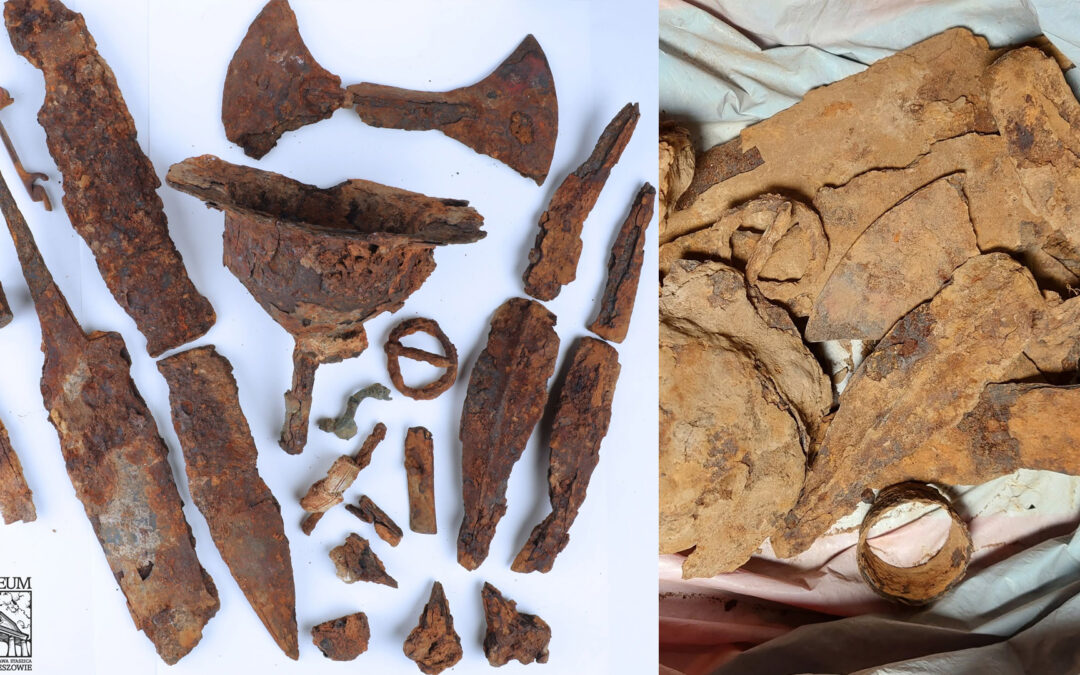
The collection includes a sword, spear and javelin heads, shield components and spurs. Museum staff do not know who originally discovered the burial or exactly where it was located, leaving the circumstances of the find largely a mystery.
The Father Stanisław Staszic Museum in Hrubieszów announced in a Facebook post that the objects had been passed to them anonymously through an intermediary.
The items are in poor condition and will undergo urgent conservation, with the iron components of the weapons particularly vulnerable after centuries in the ground.
They were also exposed to high temperatures during a burial practice in which the deceased was burned along with their personal belongings. The museum says that the nature of the objects indicates that their owner held a high social position.
The most notable object is a sword preserved in three pieces, reflecting the Vandal practice of deliberately breaking or bending weapons and other grave artefacts as part of funeral rituals. The collection also contains two spearheads, both broken.
Other items include a shield boss with a spike, a shield grip, a fragment of a knife, a belt buckle and two spurs. Fragments of a bone comb and a bronze fibula, used to fasten a cloak, were also recovered.
The circumstances surrounding the discovery and recovery of the objects remain unknown, but the museum says that, according to the information it has received, the burial site was discovered in an agricultural field several years ago in the municipality of Werbkowice.
“We intend to verify the exact location through archaeological excavations, most likely next summer,” they added. “Based on the information we have gathered, there are strong indications that there may be more similar burials in the area that have been disturbed by agricultural work.”
The opportunity to recover the objects and transfer them to an appropriate institution arose only recently. The museum said that a local metal detectorist played a key role in arranging the transfer, acting as an intermediary in securing the artefacts.
The recovery of the artefacts follows another recent archaeological discovery in the same region. In August, the museum announced that a metal boss from a warrior’s shield dating to the second century was found at a scrap metal yard near Hrubieszów.
The Vandals were an ancient Germanic people believed to have reached the territories of present-day Poland around the 3rd or 2nd century BC.
They lived in the region for several centuries and are generally associated by researchers with the Przeworsk culture, which flourished across parts of present-day Poland during the Iron Age and Roman period.
Around the turn of the 4th and 5th centuries AD, amid the expansion of the Huns, they left Central Europe and moved westwards into the declining Roman Empire. As the Vandals left Central Europe, the Slavic population gradually moved into the region over the following centuries.
Notes from Poland is run by a small editorial team and published by an independent, non-profit foundation that is funded through donations from our readers. We cannot do what we do without your support.
Main image credit: Muzeum im. ks. Stanisława Staszica w Hrubieszowie / Facebook

Alicja Ptak is deputy editor-in-chief of Notes from Poland and a multimedia journalist. She has written for Clean Energy Wire and The Times, and she hosts her own podcast, The Warsaw Wire, on Poland’s economy and energy sector. She previously worked for Reuters.