Keep our news free from ads and paywalls by making a donation to support our work!

Notes from Poland is run by a small editorial team and is published by an independent, non-profit foundation that is funded through donations from our readers. We cannot do what we do without your support.
Following a crash between a train and a truck at a rail crossing that left one passenger dead and both drivers with serious injuries, Poland’s main train drivers’ union has announced a go-slow protest that will take place on Friday.
They note that they have long been warning about a lack of sufficient safety measures at rail crossings, and say that a “red line has now been crossed”.
In the wake of Wednesday’s tragedy, Prime Minister Donald Tusk has pledged that the government will introduce “very tough” new punishments for those who violate regulations at crossings.
Poczułam takie jakby silne hamowanie, takie bardzo silne i nagle takie bujanie i do człowieka dociera, że zaraz się wykoleimy – mówiła pasażerka pociągu Intercity "Koziołek", jadącego z Lublina do Szczecina, który wykoleił się w miejscowości Sokolniki Suche w Mazowieckiem.… pic.twitter.com/enyjD2Wo6K
— tvn24 (@tvn24) September 9, 2026
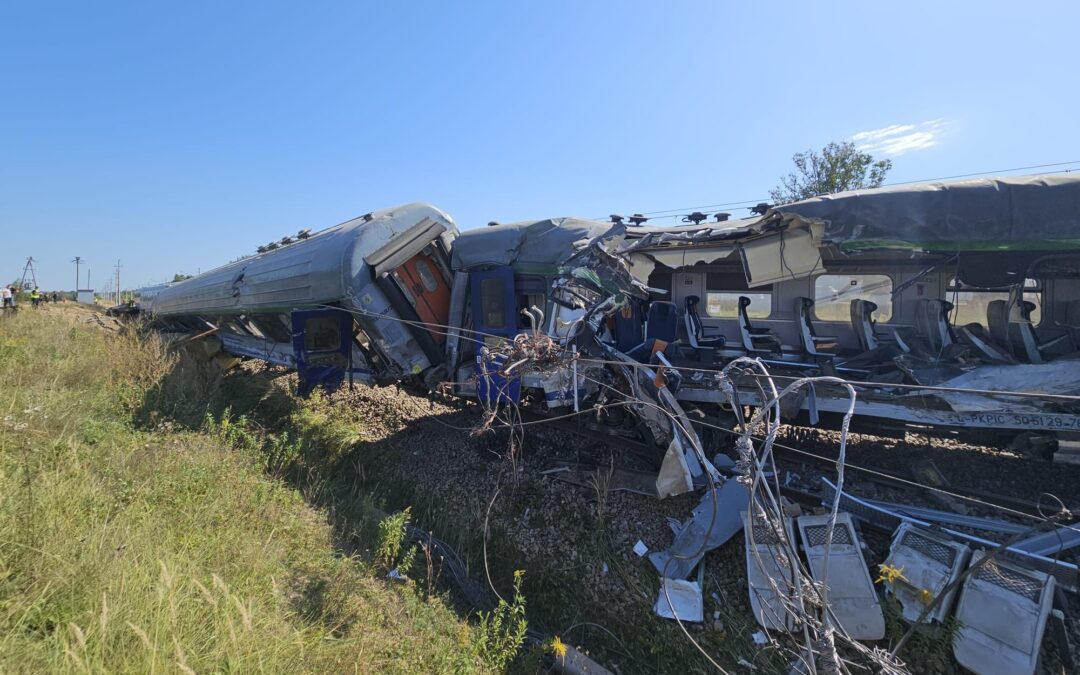
On Wednesday morning, a train travelling between the cities of Lublin and Szczecin partially derailed in the village of Sokolniki Suche in central Poland after colliding with a heavy goods vehicle that, initial findings suggest, had entered the tracks at a rail crossing despite warning lights flashing. The crossing had no barriers.
The train was carrying at least 114 people, including three crew. One passenger in the first carriage, a 39-year-old woman, died in hospital from her injuries, prosecutors announced later on Wednesday. Four others, including the drivers of both the train and the truck, remain hospitalised in serious condition.
Prosecutors say that, from the evidence collected so far, they will launch an investigation into the crime of unintentionally causing a rail disaster, which carries a prison sentence of six months to eight years. However, they have not yet been able to interview either driver due to their health conditions.
On Thursday, the head of the Polish train drivers’ union, Leszek Miętek, announced that a protest would begin at midnight and last through the whole of Friday.
“We are appealing to train drivers to travel at a safe speed of 20 km/h (12.4 mph) across every level crossing in Poland,” he said, adding that he had “received reports from across the country” that “there’s full support for this type of action”.
Miętek noted that the Polish labour code allows employees to refrain from work if they believe it poses a threat to their life or health. While drivers would not go that far, they want to demonstrate in a bid to prompt “action from those responsible for safety.” He warned that train delays should be expected on Friday.
Związek Zawodowy Maszynistów Kolejowych mówi "dość" i ogłasza ogólnokrajowy protest po tragicznej katastrofie w Sokolnikach Suchych. W piątek, 11 września, pociągi w całej Polsce będą zwalniać na przejazdach kolejowych do zaledwie 20 km/h.
Więcej o tym: https://t.co/jj6jKm40X2 pic.twitter.com/ThqfLx3dEc— TVN Warszawa (@tvnwarszawa) September 10, 2026
The union chief said that Wednesday’s accident “was not a surprise to us, considering that statistically we have an accident at a railway crossing every two days”. However, “a red line has [now] been crossed”, he added, quoted by news website Interia.
Miętek noted that, for over 18 months, the union has been running a campaign, titled “I Want To Live”, focused on safety. Just two days before the accident, it had issued a special appeal to drivers over “growing safety concerns on Polish railways”.
“We have been doing everything we can in parliament and at the infrastructure ministry to make sure this problem is noticed,” added Miętek, who also welcomed the fact that, following Wednesday’s accident, Tusk has pledged to take action.
💬 Premier @donaldtusk ⤵️
Katastrofa kolejowa w Sokolnikach miała miejsce na przejeździe kolejowym, dlatego natychmiast rozpoczniemy prace nad
zaostrzeniem przepisów dla tych, którzy wjeżdżają na przejazdy kolejowe, mimo zapór i czerwonych światel. pic.twitter.com/BgaZQLEPbR— Kancelaria Premiera (@PremierRP) September 9, 2026
In those remarks, the prime minister lamented that the accident in Sokolniki Suche was “yet another case of such a catastrophe happening at a rail crossing”.
“We must immediately begin urgent work on tightening regulations,” he continued. This would include “very tough” punishments “for those who, unfortunately, quite systematically drive onto railway crossings despite barriers and red lights”.
Infrastructure minister Dariusz Klimczak later confirmed that they were working on “radical” measures to toughen penalties for those who violate the rules at rail crossings.
He revealed that one proposal being considered is suspending for three months the licence of any driver who ignores red lights at rail crossings. However, critics noted that the ministry had already announced such plans in July 2025, and had failed to implement them since then.
– Chcemy wprowadzić przepis, na podstawie którego każdy kierowca, który wjedzie na przejazd drogowo-kolejowy kiedy jest zapalone czerwone światło, straci prawo jazdy, zostanie mu ono zatrzymane na trzy miesiące. Chcemy także zmienić kodeks karny we współpracy z ministrem… pic.twitter.com/RhE8pcvlJ9
— Ministerstwo Infrastruktury (@MI_GOV_PL) September 9, 2026
The latest data from Eurostat, the European Union’s statistics agency, show that in 2024 Poland recorded the second-highest number of rail accidents, 220, among all member states, behind only Germany (366).
However, 24% of Poland’s accidents took place at rail crossings, compared to 16% in Germany. In total, Poland had by far the highest number of deaths caused by accidents at rail crossings (45), ahead of Germany (26), France (20) and Hungary (18).
When taking into account the size of countries’ rail networks, Poland had 4.3 rail deaths (from all causes, not just accidents at crossings) per thousand kilometres of track, which was the fifth-highest figure in the EU, behind Portugal (6.2), Hungary (5.8), Slovakia (5.7) and Lithuania (4.6).
Last week, in dramatic scenes captured on camera, a train carrying almost 300 passengers hit a truck at a rail crossing in Gdańsk, luckily resulting in no injuries. The driver of the truck, who is from Bosnia and Herzegovina, has been charged.
A train crashed into a lorry stuck on a railway crossing in Gdansk, Poland, after the barriers closed while the vehicle was still on the tracks.
The lorry driver and train passengers escaped unharmed, but the train driver was taken to hospital with injuries.
Poland’s state… pic.twitter.com/Oj7x3zypF7
— TRT World (@trtworld) September 4, 2026
Notes from Poland is run by a small editorial team and published by an independent, non-profit foundation that is funded through donations from our readers. We cannot do what we do without your support.
Main image credit: Państwowa Straż Pożarna/X

Daniel Tilles is editor-in-chief of Notes from Poland. He has written on Polish affairs for a wide range of publications, including Foreign Policy, POLITICO Europe, EUobserver and Dziennik Gazeta Prawna.