Keep our news free from ads and paywalls by making a donation to support our work!

Notes from Poland is run by a small editorial team and is published by an independent, non-profit foundation that is funded through donations from our readers. We cannot do what we do without your support.
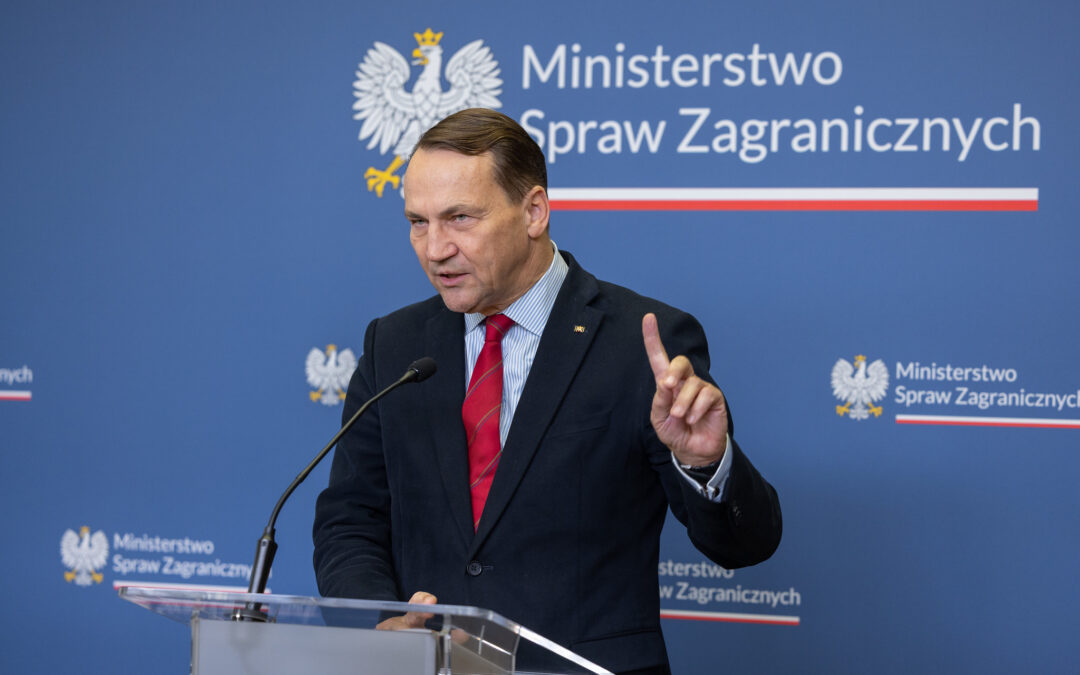
Poland’s foreign minister has expressed concern over the rise of the far-right Alternative for Germany (AfD) party at a time when Germany is rapidly rearming – suggesting that it has echoes of the build-up to World War Two.
“We want Germany, under democratic leadership and as Europe’s largest economy, to play a strong role in ensuring our common security,” Radosław Sikorski told German newspaper Handelsblatt.
“But we remember all too well where a rearmed Germany in the hands of a far-right, pro-Russian party can lead – and that is precisely what the AfD represents,” he added.
Polens Außenminister Sikorski: „Wir wollen, dass Deutschland (…) eine starke Rolle bei der Sicherung unserer gemeinsamen Sicherheit spielt. Aber wir erinnern uns nur allzu gut daran, wohin ein wiederbewaffnetes Deutschland in den Händen einer rechtsextremen, prorussischen Partei führen kann (…)“
— Andreas Prause (@andreas-prause.eu) 8 September 2026 at 21:05
Poland was, on 1 September 1939, invaded by Nazi Germany, marking the start of World War Two and over five years of brutal occupation. The attack was launched in cooperation with the Soviet Union, which invaded Poland from the east two weeks later.
After Hitler was defeated, Germany had no major far-right party for decades. However, that has changed in recent years. In 2024, the AfD came first in the Thuringian state election, with 33% of the vote. Last Sunday, it won in Saxony-Anhalt, with 44%.
The party also came second in the federal elections of 2025, with 21%, making it the main national opposition. Opinion polls now show that the AfD is the most popular party nationally, with support of around 28%, well ahead of Chancellor Friedrich Merz’s Christian Democratic Union (CDU), on 21%.
The AfD’s growth has been watched with particular concern in Poland, a country that suffered enormously under Nazi-German occupation. Some senior AfD figures have sought to downplay the significance of the Nazi era.
In 2025, when the German parliament approved plans for a memorial in Berlin to Polish victims of World War Two, the AfD was the only party not to vote in favour.
The AfD’s sympathy towards and links with Russia have caused further disquiet in Poland. Last year, AfD co-leader Tino Chrupalla said he “does not see any current threat to Germany from Russia” and that, in fact, “Poland could also be a threat to us”.
This year, another senior AfD figure, Kay Gottschalk, called for Poland to pay his country €1.3 billion as reparations for its “complicity” in the sabotage of the Nord Stream gas pipelines that used to bring Russian gas to Germany through the Baltic Sea but were damaged by explosions in 2022.
Germany’s parliament has passed a motion calling on the government to establish a permanent memorial in Berlin to Polish victims of the German-Nazi occupation.
The measure was supported by all parties apart from the far-right AfD https://t.co/8dk0ZSpmjJ
— Notes from Poland 🇵🇱 (@notesfrompoland) December 3, 2025
In the wake of the AfD’s victory in Saxony-Anhalt on Sunday, Polish Prime Minister Donald Tusk declared that “only idiots or traitors” in Poland would celebrate an AfD victory. He claimed there were some such people in Law and Justice (PiS) and Confederation (Konfederacja), the two main right-wing opposition parties.
However, PiS’s reaction to AfD’s rise has been mixed. On Tuesday, PiS MP Małgorzata Golińska told Polskie Radio that it represents a “kind of browning” of politics in Germany – a reference to the brown shirts of Hitler’s SA paramilitary forces that helped bring him to power in the 1920s and 1930s.
“A return to very dangerous thinking is taking place there and we must observe in which direction it will all develop,” added Golińska. “From Poland’s perspective, we should not overreact with any particular emotion, but we also cannot be naive [in thinking] that nothing is happening there.”
By contrast, another PiS MP, Jarosław Sellin, told Onet Radio that PiS and the AfD “say similar things” when it comes to EU climate and migration policies. But he added that “this does not mean we have to like what the AfD says about history, relations with Poland, and Russia”.
Polish PM @donaldtusk has condemned as “idiots or traitors” right-wing opposition figures who have welcomed the far-right AfD's election victory in Germany
However, the response from the Polish right to the election result has so far been relatively muted https://t.co/goSWlbeGA8
— Notes from Poland 🇵🇱 (@notesfrompoland) September 7, 2026
Responses from Confederation have likewise been mixed. The group is actually made up of two main factions, one of which, a libertarian party called New Hope (Nowa Nadzieja), is allied with the AfD in the European Parliament.
New Hope’s spokesman, Wojciech Machulski, told the Fakt daily that they are “united [with AfD] in our opposition to EU migration and climate policies” but at the same time “we do not accept the anti-Polish statements”.
Krzysztof Mulawa, an MP from the National Movement (RN), which makes up the other half of Confederation, told the newspaper that “several of the AfD’s demands are unacceptable from the Polish perspective”. But he said that there were areas of shared interest, such as abolishing the euro.
A number of figures from PiS and Confederation have also expressed hope that the AfD’s rise at the expense of establishment parties can herald a similar development in Poland, which, like Germany, is ruled by a pro-EU coalition ranging from centre-left to centre-right.
Europa się budzi, a establishment wpada w panikę. Wynik AfD pokazuje, że ludzie mają dość dyktatu Brukseli, Zielonego Ładu i niszczenia państw narodowych przez nielegalną imigrację. Polityczne trzęsienie ziemi dopiero się zaczyna. Piękna, biała Europa narodów wkrótce powróci.
— Włodzimierz Skalik (@Wlodek_Skalik) September 7, 2026
One party that has been unambiguously positive in its response to AfD’s victory is the Confederation of the Polish Crown (KKP), a radical-right, pro-Russian group that broke away from Confederation last year and is currently polling support of around 9%
“Europe is waking up, and the establishment is falling into panic,” wrote KKP’s deputy leader, Włodzimierz Skalik, on social media. “A beautiful, white Europe of nations will soon return.”
Notes from Poland is run by a small editorial team and published by an independent, non-profit foundation that is funded through donations from our readers. We cannot do what we do without your support.
Main image credit: Poland MFA/Flickr (under CC BY-ND 4.0)

Daniel Tilles is editor-in-chief of Notes from Poland. He has written on Polish affairs for a wide range of publications, including Foreign Policy, POLITICO Europe, EUobserver and Dziennik Gazeta Prawna.