Keep our news free from ads and paywalls by making a donation to support our work!

Notes from Poland is run by a small editorial team and is published by an independent, non-profit foundation that is funded through donations from our readers. We cannot do what we do without your support.
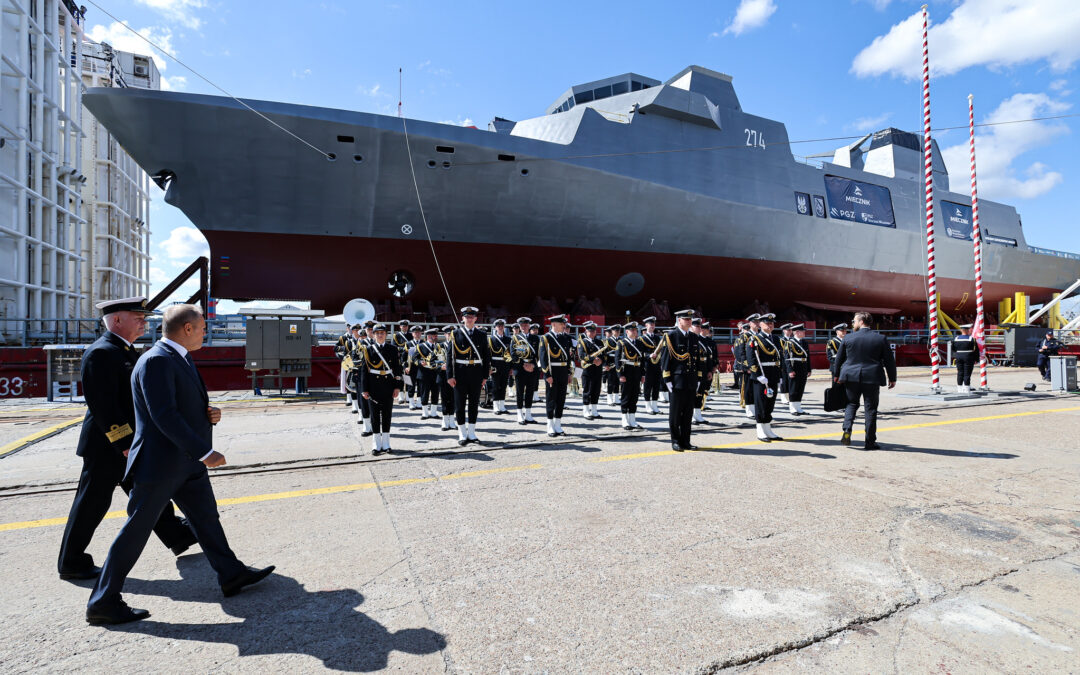
Poland has unveiled its first frigate to enter service in decades at a ceremony in the Baltic Sea port of Gdynia, where the ship was constructed.
The development marks a major milestone in a 15 billion zloty (€3.5 billion) programme to modernise the ageing Polish navy and strengthen NATO’s maritime defences.
“Poland is becoming a maritime power in the Baltic Sea,” declared Prime Minister Donald Tusk at a ceremony to name the new ship, which he attended alongside opposition-aligned President Karol Nawrocki in a rare show of unity.
Na terenie PGZ Stoczni Wojennej w Gdyni prezydent RP Karol Nawrocki, @PremierRP @donaldtusk oraz wiceministrowie @MON_GOV_PL @magdasobkowiak i @pawelbejda uczestniczą w uroczystości chrztu pierwszej jednostki programu „Miecznik”, fregaty wielozadaniowej – przyszłego ORP Wicher. pic.twitter.com/X2ftjoKTLZ
— Ministerstwo Obrony Narodowej 🇵🇱 (@MON_GOV_PL) August 12, 2026
The ORP Wicher, a medium-sized warship designed for escort, air defence and other fleet protection duties, is the first of three multi-role frigates based on Britain’s Arrowhead 140 design being built under Poland’s Miecznik programme, the largest modernisation project in the history of the Polish Navy.
It is due to be launched on Thursday in a complex manoeuvre involving its transfer and controlled launch from a semi-submersible barge. Shipyard officials have described the operation as one of the most demanding engineering projects undertaken by Poland’s shipbuilding industry.
The three frigates are intended to form the core of Poland’s surface fleet and will replace Poland’s two current Oliver Hazard Perry-class frigates, which were constructed in the 1970s and transferred from the US Navy in the years 2000 and 2002.
Ahead of Wicher’s launch, leading Polish officials attended the naming ceremony in Gdynia, including Tusk and Nawrocki, who are normally bitter rivals but have sought to present a more united front when it comes to national defence.
“There can be no arguments or disputes when it comes to our country’s security,” said Tusk, who declared that Poland was seeking to play a role in “determining not only its own future, but also the entire region and Europe”.
Nawrocki, meanwhile, said that the modernisation of the Polish navy “sends a clear message that we will develop our armed forces in every theatre – on water, on land, and in the air”.
Both leaders also hailed the fact that the new frigates are being built in Poland itself, helping bolster the Polish shipbuilding industry.
Prezydent RP @NawrockiKn w #Gdynia: Życzę, abyście zawsze szczęśliwie wracali do portu, któremu na imię Polska. pic.twitter.com/hHia2sCZfn
— Kancelaria Prezydenta RP (@prezydentpl) August 12, 2026
The contract for the three frigates was signed in 2021 between Poland’s state Armament Agency (AU) and a consortium led by state-owned defence group PGZ, with British defence firm Babcock and other foreign partners also involved.
The project was initially valued at about 8 billion zloty but had risen to around 15 billion zloty by the end of 2023 following amendments.
Construction of the second frigate in Gdynia’s military shipyard began in May 2025, while work on the third began in April this year. The programme is scheduled to be completed by the end of 2031.
Swedish defence giant Saab has signed a strategic collaboration agreement with Polish state defence group PGZ.
The firms will cooperate on naval production, servicing and technology, including establishing an underwater technology centre in Poland https://t.co/dykKjMIAzX
— Notes from Poland 🇵🇱 (@notesfrompoland) May 15, 2026
The ships are more than 140 metres long and are based on Britain’s Arrowhead 140 design, developed by Babcock and adapted to Polish military requirements.
The frigates will be equipped with British CAMM and CAMM-ER surface-to-air missiles, naval guns and anti-ship missiles capable of striking targets at ranges of more than 200 km.
Their missions will include protecting shipping lanes and critical energy infrastructure and taking part in NATO naval groups.
NATO has launched a new military operation in the Baltic Sea, an idea promoted by Poland last year in response to sabotage targeting undersea cables.@donaldtusk said at today's summit that "all signs point to Russia" being responsible for the damage https://t.co/cBPdL1fKkK
— Notes from Poland 🇵🇱 (@notesfrompoland) January 14, 2025
Since Russia’s full-scale invasion of Ukraine in 2022, Poland has embarked on a major defence procurement spree. It now has the highest relative defence budget in NATO and is also the alliance’s largest arms importer.
In recent years, Poland has also increasingly oriented itself towards the Baltic region, forming closer economic, energy and military ties with allies around the sea.
Last year, Poland and Sweden signed a strategic partnership on defence and economic ties. They subsequently held their first ever bilateral military exercises in the Baltic.
As part of its naval modernisation programme, Poland has selected Sweden’s Saab as the supplier for three advanced A26 stealth submarines in a deal worth around €4.5 billion.
Poland has signed a €4.5 billion deal to buy three A26 submarines from Sweden.
The agreement was announced amid intergovernmental consultations today between the two countries, further cementing an increasingly important alliance in the Baltic region https://t.co/VsiOTVRzPI
— Notes from Poland 🇵🇱 (@notesfrompoland) June 29, 2026
Notes from Poland is run by a small editorial team and published by an independent, non-profit foundation that is funded through donations from our readers. We cannot do what we do without your support.
Main image credit: KPRM/Flickr (under CC BY-NC-ND 4.0)

Alicja Ptak is deputy editor-in-chief of Notes from Poland and a multimedia journalist. She has written for Clean Energy Wire and The Times, and she hosts her own podcast, The Warsaw Wire, on Poland’s economy and energy sector. She previously worked for Reuters.