
Keep our news free from ads and paywalls by making a donation to support our work!

Notes from Poland is run by a small editorial team and is published by an independent, non-profit foundation that is funded through donations from our readers. We cannot do what we do without your support.
Archaeologists have uncovered evidence of rituals involving drinking lactose-reduced dairy around 5,500 years ago in what is now north-central Poland. The researchers note that lactose intolerance was widespread during that period.
The excavations in Sławęcinek, the site of an ancient settlement discovered in 2016, also contain depictions of perhaps some of the world’s earliest known examples of wheeled transport and hint at the existence of women’s secret societies and matrilineal culture.
The finds reveal some of the customs of the Funnel Beaker Culture from around 3500 BCE in the Neolithic period, which the researchers describe in a new academic paper as “successors of the first farmers” who “promoted a mixed-farming economy and paved the way for new social and religious developments”.
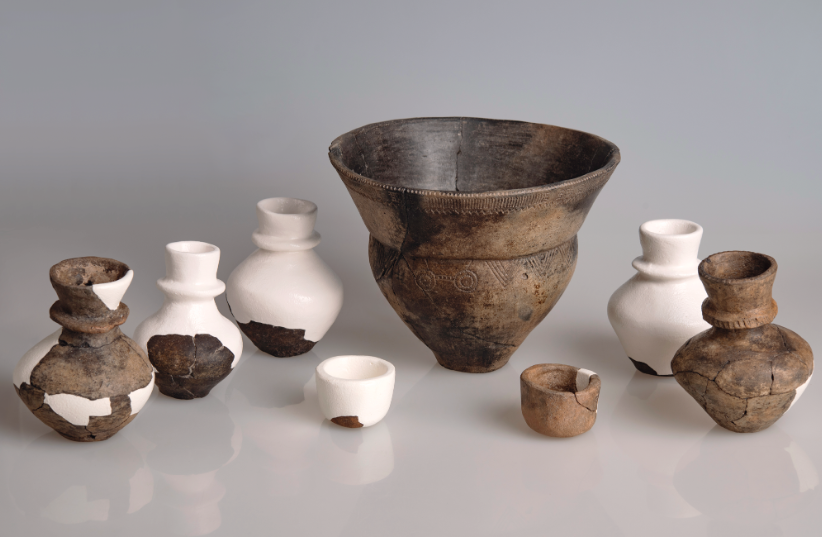
The team, from Polish and British universities, have unearthed around 6,300 pieces of broken pottery. Among these was a special set of drinking vessels, including a funnel beaker, five collared flasks and two ceramic cups.
These were likely used for the pouring and consumption of dairy beverages during rituals. Residue analysis of the old equipment showed that it contained traces of low-lactose dairy, indicating that the milk had been processed.
“Lactose intolerance was common during the Neolithic, affecting almost every inhabitant of Europe until the Late Bronze Age,” the study’s lead author, Łukasz Kowalski of Nicolaus Copernicus University in Toruń, told Science in Poland.
“Processing milk into products with lower lactose content was therefore an important way to utilise this valuable resource,” he added.
The researchers believe that the drinking rituals may have been linked to funerals. Near the uncovered drinking vessels, they found only the remains of women.
“We therefore hypothesised that the rituals that took place in Sławęcinek could have been related to matrilineality and possibly also to secret women’s societies,” said Kowalski.
“The use of collared flasks for serving and consuming dairy products, which could be perceived as a liquid of fertility and health symbolising the mother, opens the possibility of interpreting these practices as rituals strengthening bonds between women within the group,” he added.
Thousands of bones or their fragments, mostly belonging to cattle, sheep and pigs, have also been found at the site. The researchers believe they could also be evidence of “feasting debris associated with the drinking rituals”.
The surface of one of the cups includes an image featuring circles and lines, possibly depicting a vehicle. Researchers say that if confirmed, the image could represent one of the oldest known depictions of wheeled transport in the world.
The first ever Celtic ritual lake site in Poland has been discovered.
The find, dated to the third century BC, is described by archaeologists as “revolutionary” as it will require them to rethink the history of the Celts in what is now Poland https://t.co/QN4yFSbZjN
— Notes from Poland 🇵🇱 (@notesfrompoland) June 11, 2024
Notes from Poland is run by a small editorial team and published by an independent, non-profit foundation that is funded through donations from our readers. We cannot do what we do without your support.
Main image credit: W. Ochotny / Praehistorische Zeitschrift 2025

Olivier Sorgho is senior editor at Notes from Poland, covering politics, business and society. He previously worked for Reuters.