Keep our news free from ads and paywalls by making a donation to support our work!

Notes from Poland is run by a small editorial team and is published by an independent, non-profit foundation that is funded through donations from our readers. We cannot do what we do without your support.
The chief justice of Poland’s Constitutional Tribunal (TK), Bogdan Święczkowski, has refused to accept four new judges after they arrived at the court today following a controversial swearing-in ceremony in parliament.
Święczkowski noted that, although the judges were elected by the government’s majority in parliament, they had not, as required, taken their oath before opposition-aligned President Karol Nawrocki, who has raised doubts over their appointment.
The chief justice’s decision, which was widely expected, deepens an unprecedented standoff over the court – and Poland’s judicial system more broadly – between the government and officials aligned with the national-conservative opposition Law and Justice (PiS) party, which ruled Poland from 2015 to 2023.
Prezes Trybunału Konstytucyjnego przyjął sześć osób wybranych przez Sejm na stanowisko sędziego TK, w tym dwie, które są już sędziami Trybunału ponieważ skutecznie złożyły ślubowanie przed Prezydentem.
Dwójce sędziów Prezes Święczkowski przydzielił sprawy do orzekania, natomiast… pic.twitter.com/TAv1JBt9Ho
— Agnieszka Jędrzak (@ajedrzak) April 9, 2026
Last month, the ruling coalition’s majority in the Sejm, the more powerful lower house of parliament, chose six new judges to fill empty seats on the TK, which since December has had only nine of its 15 positions filled. At least 11 judges are required for the court to have a valid bench.
Under the law, new TK judges must “take an oath before the president” before taking up their seats on the court. However, last week, Nawrocki invited only two of the six judges, Dariusz Szostek and Magdalena Bentkowska, to take an oath in the presidential palace.
His chief of staff, Zbigniew Bogucki, said that the president had done so, despite doubts about the legality of the judge’s appointment by parliament, because adding two judges would bring the TK up to its valid bench of 11. He also noted that only two TK vacancies had opened up since Nawrocki became president.
However, many legal experts have rejected those arguments, saying that if Nawrocki accepted two of parliament’s appointments as valid, he must also accept the other four. Last week, PiS suspended one of its own MPs, Krzysztof Szczucki, a doctor of law, who had agreed with that opinion.
On Thursday, after repeatedly asking Nawrocki to receive their oath, the four remaining judges – Anna Korwin-Piotrowska, Krystian Markiewicz, Maciej Taborowski and Marcin Dziurda – decided instead to organise their own ceremony in the Sejm, to which they invited the president.
Bogucki condemned their decision as an “ostentatious and conscious…violation of the law”. But the four judges went ahead anyway, and were joined by Szostek and Bentkowska in a show of support. Four former chief justices of the TK also attended the ceremony.
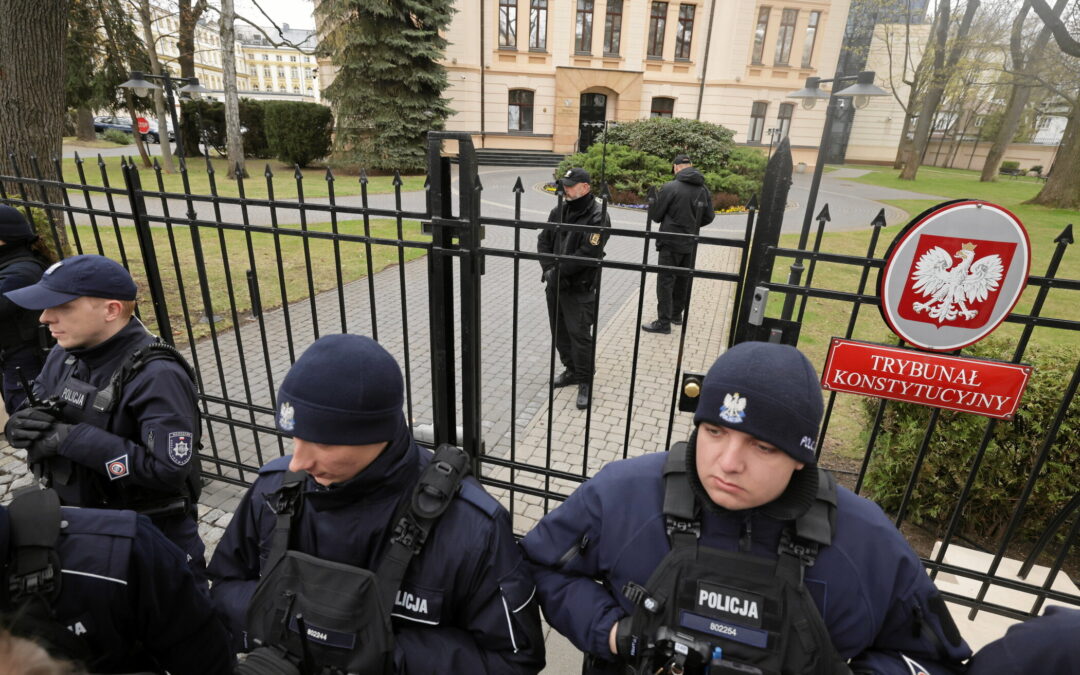
After swearing their oath in the presence of a notary, the six judges delivered the documentation to the presidential chancellery. They then proceeded to the TK itself, where dozens of protesters had gathered outside amid a heavy police presence.
There had been some speculation that Święczkowski, who served in the former PiS government and has regularly clashed with the current government, might seek to prevent the judges from entering the building. However, all six made their way inside, where they met with the chief justice.
Poland’s rule-of-law crisis took a new twist today as parliament – which is controlled by the ruling coalition – hosted the swearing in of four constitutional court judges whose oaths opposition-aligned President Karol Nawrocki has refused to receive https://t.co/9Mu8tSrCxw
— Notes from Poland 🇵🇱 (@notesfrompoland) April 9, 2026
Around two hours later, Święczkowski spoke to the media, saying that, while he had “congratulated all six on their election”, he had only allowed the two judges who had sworn oaths before Nawrocki to take up their positions on the court, where they had already been assigned cases.
Meanwhile, he had informed the other four that “unfortunately I cannot recognise…[them] as judges of the Constitutional Tribunal as I have not been informed by the president that they took the oath before him”.
He also criticised them for taking part in today’s alternative swearing-in ceremony in parliament, which he described as ” a performance, a media spectacle, organised, in my opinion, for the benefit of politicians”.
💬 "Niestety nie mogę uznać, że sędziowie, którzy nie złożyli ślubowania wobec prezydenta, mogą nawiązać stosunek służbowy sędziego TK."
Bogdan Święczkowski o sytuacji sędziów Trybunału Konstytucyjnego 👇 pic.twitter.com/t23KKBN5oe
— tvp.info 🇵🇱 (@tvp_info) April 9, 2026
In response to Święczkowski’s remarks, a government minister, Maciej Berek, said that, by congratulating all six judges on their election by parliament, the chief justice had confirmed they were legally appointed.
That, said Berek, undermines Nawrocki’s claims that there are doubts over their legality and confirms that he has “usurped a non-existent presidential power” by deciding who can or cannot be a TK judge.
Meanwhile, before Święczkowski’s statement, justice minister Waldemar Żurek told broadcaster TVN that the government has a “plan B” if four of the judges were not accepted onto the TK. However, he refused to say what this would involve.
B. Święczkowski poinformował właśnie publicznie, że jako prezes TK pogratulował całej szóstce wybranych przez Sejm sędziów tego, że zostali sędziami wybrani. Czyli nawet tam nie ma wątpliwości, że wybór był prawidłowy.
I oto się posypała opowieść Kancelarii @prezydentpl o tym,…— Maciej Berek (@MaciejBerek) April 9, 2026
Later, in a press conference of his own, Bogucki said that Nawrocki would ask the TK itself to rule on the dispute between parliament and the president over the appointment of the four remaining judges.
“Until the Constitutional Tribunal issues a position, the president will not act,” said Bogucki, quoted by news website Onet. He also called today’s actions by the four judges “a grotesque farce”.
However, even if the TK does rule on the issue, its decision is likely to be ignored by the ruling coalition, which regards the TK as illegitimate since it contains judges unlawfully appointed when PiS was in power. The current government has refused to recognise – or even publish – TK rulings.
Fifteen months since the change of government, Poland's rule-of-law crisis continues – indeed, many Poles think the situation has got worse.@J_Jaraczewski explains the roots of the crisis, what its impact has been, and how it might be resolved https://t.co/7KOCURV3dU
— Notes from Poland 🇵🇱 (@notesfrompoland) March 17, 2025
Notes from Poland is run by a small editorial team and published by an independent, non-profit foundation that is funded through donations from our readers. We cannot do what we do without your support.
Main image credit: Kuba Atys / Agencja Wyborcza.pl

Daniel Tilles is editor-in-chief of Notes from Poland. He has written on Polish affairs for a wide range of publications, including Foreign Policy, POLITICO Europe, EUobserver and Dziennik Gazeta Prawna.