Keep our news free from ads and paywalls by making a donation to support our work!

Notes from Poland is run by a small editorial team and is published by an independent, non-profit foundation that is funded through donations from our readers. We cannot do what we do without your support.
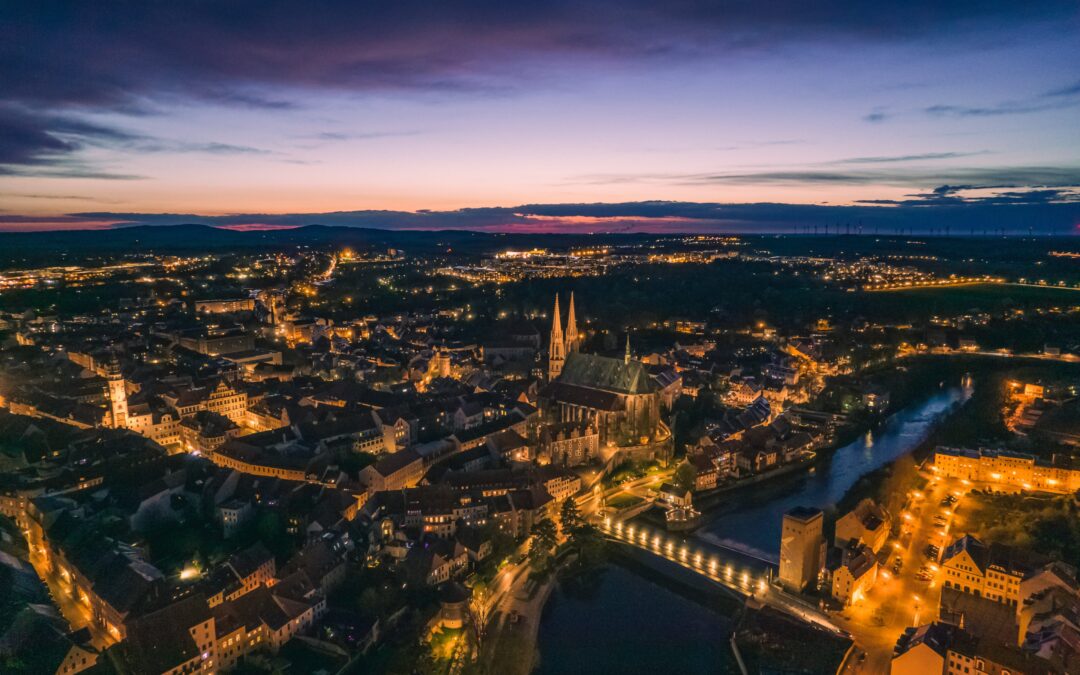
Poland and Germany have launched construction of a pioneering cross-border heating system that will connect the Polish city of Zgorzelec with its German counterpart Görlitz and will be powered entirely from renewable sources.
The project, called United Heat, was launched with a groundbreaking ceremony last week attended by Polish energy minister Miłosz Motyka and Germany’s federal minister for economic affairs and energy, Katherina Reiche.
Under the plans, the two cities – which sit on either side of the Lusatian Neisse river that marks the Polish-German border and have a combined population of around 85,000 – will connect their heating networks by 2028.
Meanwhile, they will construct a 25 megawatt (MW) biomass heating plant in Zgorzelec (work on which has already begun), solar collectors, and heat pumps (which will extract heat from Berzdorf Lake in Görlitz).
As a result, once work is complete in 2030, United Heat will be fully supplied by renewable and low-emission energy sources, preventing an estimated 50,000 tonnes of CO2 emissions annually, according to those behind the project. That is the equivalent of annual emissions from 28,000 passenger vehicles.
That achievement takes on particular symbolic significance given that the regions in which the cities are located, Upper Lusatia and Lower Silesia, have long been associated with the coal industry.
Meanwhile, the costs of heating from the system will be “maintained at socially acceptable levels”, says the Polish energy ministry.
The project “is a very important step for energy security, but also a symbolic gesture of partnership and our shared responsibility,” said Motyka. It will “enable knowledge exchange, the implementation of innovation, and the creation of systems resilient to fluctuations in the energy market”.
Reiche added that the United Heat will show how to “decarbonise the heating sector in a cost-effective way…for the benefit of businesses and consumers”. Görlitz’s mayor, Octavian Ursu, hailed it as “a symbol of successful European cooperation and a determined path toward climate neutrality”.
The project was formally initiated in 2020, when the two cities signed a letter of intent. Over the following years, they conducted feasibility studies and sought funding from the European Commission.
The EU will cover around 50% of the costs, which are estimated at around €190 million (812 million zloty). Reiche revealed last week that Germany is contributing €81.6 million. The size of Poland’s contribution has not been announced.
Notes from Poland is run by a small editorial team and published by an independent, non-profit foundation that is funded through donations from our readers. We cannot do what we do without your support.
Main image credit: United Heat (press materials)

Daniel Tilles is editor-in-chief of Notes from Poland. He has written on Polish affairs for a wide range of publications, including Foreign Policy, POLITICO Europe, EUobserver and Dziennik Gazeta Prawna.