Keep our news free from ads and paywalls by making a donation to support our work!

Notes from Poland is run by a small editorial team and is published by an independent, non-profit foundation that is funded through donations from our readers. We cannot do what we do without your support.
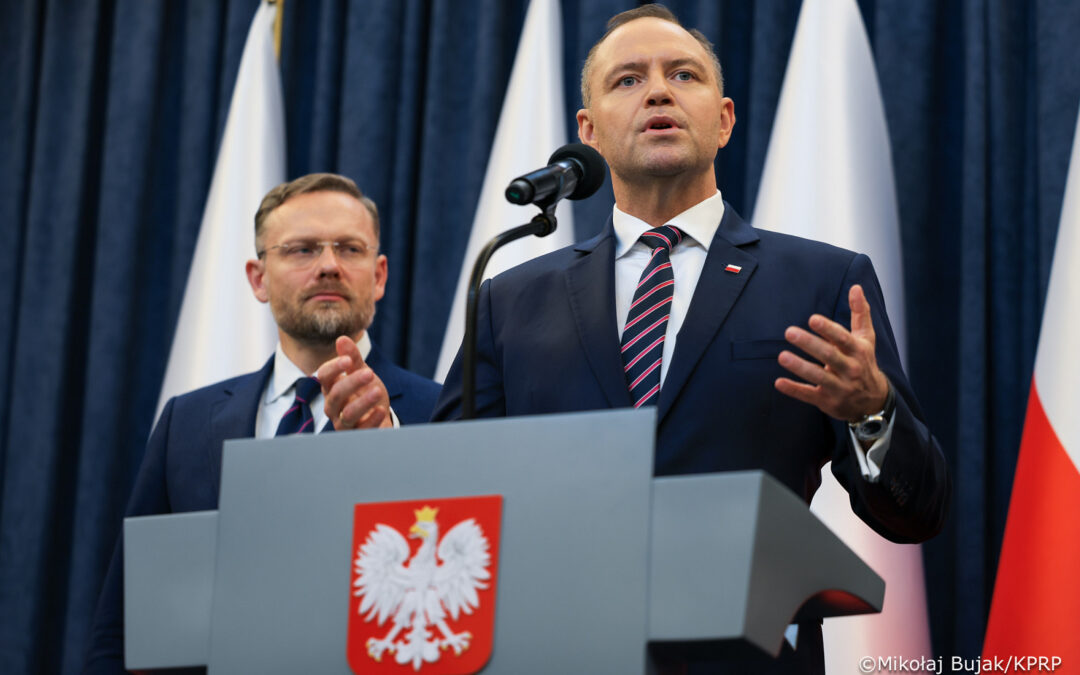
Opposition-aligned President Karol Nawrocki has received the oaths of two new judges appointed by the governing coalition to the Constitutional Tribunal (TK), a body at the heart of Poland’s rule-of-law crisis.
It is the first time a new TK justice has been sworn in in over four years, amid a standoff between the government and opposition over the court. However, the situation is far from resolved, as Nawrocki has indicated he will not receive the oaths of four other TK judges recently chosen by parliament.
Dwoje z sześciorga nowo wybranych sędziów @TK_GOV_PL złożyło ślubowanie w Pałacu Prezydenckim w Warszawie. To Magdalena Bentkowska oraz Dariusz Szostek. Nie wiadomo, czy dojdzie do ślubowania pozostałych czterech wybranych w marcu sędziów TK.https://t.co/DEbVDQzrfl
— tvp.info 🇵🇱 (@tvp_info) April 1, 2026
After the current government, a coalition led by Prime Minister Donald Tusk, came to power in 2023, it refused to appoint new judges to the TK when vacancies arose at the end of existing judges’ terms.
That was because it regards the court as illegitimate since it contains judges unlawfully appointed under the rule of the former Law and Justice (PiS) government and PiS-aligned President Andrzej Duda. The government refuses to recognise – or even publish – TK rulings.
As a result, since December 2025 – when one judge’s nine-year term expired and another retired for health reasons – only nine of the TK’s 15 seats have been filled. That is below the figure of 11 judges required for the court to have a full, valid bench.
In March, the government finally ended its boycott on TK appointments. Its majority in the Sejm, the lower house of parliament, chose six judges to fill all the empty seats on the TK.
But, under the law, new TK judges must “take an oath before the president” within 30 days of being elected by parliament before taking up their seats on the court.
That raised concern that Nawrocki, who is aligned with PiS, would refuse to invite the judges to be sworn in. Duda did something similar in 2015, refusing to swear in three judges legally chosen by parliament.
On Tuesday this week, Nawrocki’s chancellery invited only two of the six judges, Dariusz Szostek and Magdalena Bentkowska, to the presidential palace to take their oaths the following day. No official reason was initially provided as to why the president had decided to choose only those two judges.
The government’s majority in parliament has chosen six judges to fill vacancies at the constitutional court.
However, it faces a potential standoff with opposition-aligned President Nawrocki, who could refuse to swear in the new judges https://t.co/dzd570TGWK
— Notes from Poland 🇵🇱 (@notesfrompoland) March 13, 2026
Asked by news website Onet whether he would attend, despite four of his colleagues not being invited, Szostek said that he was obliged to do so as “refusing to take the oath before the president is tantamount to resigning from being a judge of the Constitutional Tribunal”.
On Wednesday morning, he and Bentkowska arrived at the palace and, shortly afterwards, confirmed that they had taken their oaths before the president.
However, Bentkowska immediately called for Nawrocki to also invite the remaining four judges, saying that he “cannot censor the choice made by the Sejm”, reports news website Wirtualna Polska.
Sędzia Dariusz Szostek, drugi z zaprzysiężonych sędziów, zabrał głos po ślubowaniu ➡️ https://t.co/y8yLniWVU3 pic.twitter.com/KE4gxmRqZ6
— Onet Wiadomości (@OnetWiadomosci) April 1, 2026
Subsequently, Nawrocki’s chief of staff, Zbigniew Bogucki, gave a press conference at which he confirmed that Szostek and Bentkowska had been sworn in and gave two reasons why the president had made this decision, rather than swearing in all six judges.
First, because only two vacancies on the court have arisen since Nawrocki took office in August last year. Second, because swearing in two new judges brings the total number up to 11 and therefore allows the TK to operate without any doubts about its legality.
However, Jakub Jaraczewski, a rule-of-law expert at Democracy International, told Notes from Poland that the justifications presented by Bogucki for Nawrocki’s decision “do not make much legal sense, and feel like an attempt to dress a political argument in legal clothing”.
“The arguments from the president’s office and PiS politicians are increasingly erratic and self-contradictory,” said Jaraczewski. “Polish law does not require the president to swear in only judges elected to fill seats emptied during the current presidential term.
Bogucki o zaprzysiężeniu 2 sędziów:
„W czasie kadencji prezydenta Karola Nawrockiego powstały w TK dwa wakaty. Ślubowanie dwojga sędziów wypełnia wymóg, by był możliwy pełen skład TK, czyli minimum 11 sędziów. Prezydent oczekuje od rządu, że wyroki TK będą publikowane” pic.twitter.com/CTGUCBoSeR
— chrzanik (@chrzanikx) April 1, 2026
The government has indicated that it has a “plan B” in place should the president refuse to swear in any judges. That would likely involve them taking their oath elsewhere, probably in parliament, and then communicating it to the president, for example in an official letter.
“Taking an oath ‘before the president’ may no longer mean ‘directly face to face, in the presence of the president’,” justice minister Waldemar Żurek told the Polish Press Agency (PAP) on Wednesday morning. “We have various options.”
Żurek noted that the law does not give the president the authority to choose who becomes a TK judge and accused Nawrocki of “once again trying to usurp power” by receiving the oaths of only two of the six judges.
Pan Minister Waldemar Żurek powiedział w środę w Studiu PAP, że dopuszcza inne warianty złożenia ślubowania przez sędziów Trybunału Konstytucyjnego. Dzisiaj już, jak widać, „wobec prezydenta” może nie oznaczać „bezpośrednio, twarzą w twarz, przy prezydencie” – stwierdził. pic.twitter.com/m0Bowqxgre
— Gosia Hebzie (@GosiaHebzie) April 1, 2026
However, during his remarks on Wednesday afternoon, Bogucki made clear that the president would not accept any oaths not taken in his presence, and warned of legal consequences for anyone who attempts to circumvent the established process.
“There is no legal basis for the oath to be taken in any other way [then before the president], let alone before any other body,” he said. Anyone who tries to “create crazy constitutional concepts” would be committing “a serious criminal offence”.
Meanwhile, given that the chief justice of the TK is Bogdan Święczkowski, a former member of the PiS government who has regularly clashed with the current government, it appears certain that he would also seek to prevent any judges not approved by Nawrocki from joining the court.
Poland’s Constitutional Tribunal has rejected a request by the justice minister to lift the immunity of the court’s chief justice to face charges of abusing his powers when he served as a senior prosecutor under the former PiS government https://t.co/FvrmxOBxEH
— Notes from Poland 🇵🇱 (@notesfrompoland) October 17, 2025
Notes from Poland is run by a small editorial team and published by an independent, non-profit foundation that is funded through donations from our readers. We cannot do what we do without your support.
Main image credit: Mikołaj Bujak/KPRP

Daniel Tilles is editor-in-chief of Notes from Poland. He has written on Polish affairs for a wide range of publications, including Foreign Policy, POLITICO Europe, EUobserver and Dziennik Gazeta Prawna.