Keep our news free from ads and paywalls by making a donation to support our work!

Notes from Poland is run by a small editorial team and is published by an independent, non-profit foundation that is funded through donations from our readers. We cannot do what we do without your support.
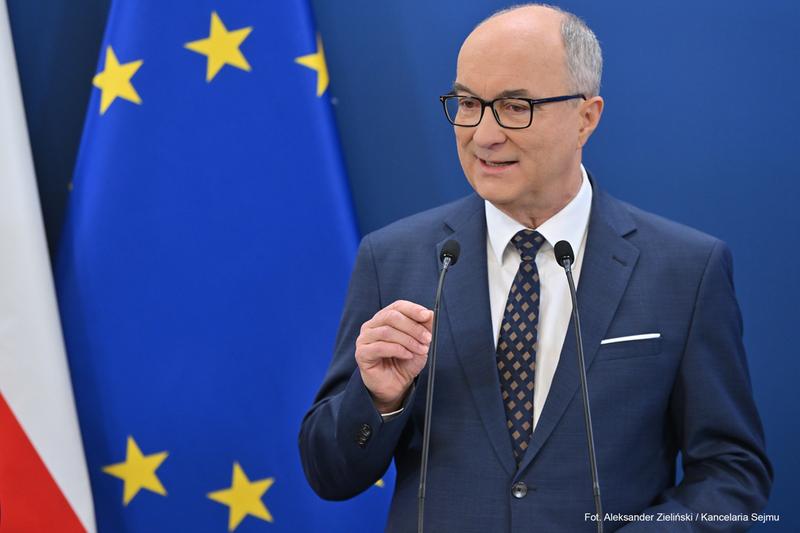
Parliament will not proceed with work on a bill proposed by opposition-aligned President Karol Nawrocki to use central bank profits for defence spending as an alternative to EU loans, the speaker of the more powerful lower-house Sejm has announced.
Włodzimierz Czarzasty said that preliminary analysis of the legislation indicates that it may be unconstitutional. He also noted that the bill fails to identify what the source of the funds would be as well as the financial impact of the plan.
Prezydencki projekt ustawy o Polskim Funduszu Inwestycji Obronnych nie otrzyma sejmowego numeru druku i nie będzie procedowany, dopóki nie zostanie szczegółowo przeanalizowany – poinformował na konferencji prasowej marszałek Sejmu @wlodekczarzasty. Chodzi o tzw. projekt „SAFE… pic.twitter.com/2AvpMEaZcD
— Sejm RP🇵🇱 (@KancelariaSejmu) March 19, 2026
Nawrocki last week submitted his plan to parliament, describing it as a “sovereign Polish” alternative to the government’s move to take nearly €44 billion in loans from the EU’s SAFE programme for defence spending.
A few days later, the president vetoed a government bill intended to facilitate the receipt and disbursement of the SAFE funds. Nawrocki argues that the EU programme would indebt Poles for decades on uncertain terms and would undermine Polish sovereignty by handing Brussels influence over defence spending.
By contrast, the president claims that his plan, which involves using profits from the central bank’s gold reserves, would provide a similar level of defence funding to the EU’s loans but, unlike them, would be interest-free and would not carry the risk of the EU interfering in Poland’s internal affairs.
However, on Thursday, Czarzasty, a senior figure in Prime Minister Donald Tusk’s ruling coalition, said that preliminary analysis by parliamentary lawyers found that Nawrocki’s proposal may violate article 221 of the Polish constitution, which gives the government the exclusive right to propose legislation on financial guarantees.
In addition, the speaker’s office noted that “the bill fails to identify any real sources of financing or provide a detailed analysis of the financial impact of implementing the presidential programme”.
“If the [central bank] fails to report a profit, the liabilities incurred under the act are to be covered by the state treasury. Therefore, the sources of financing are highly uncertain,” said Czarzasty.
Ratings agency Fitch has again warned that the "political gridlock" between Poland's government president – such as the current clash over EU defence loans – is hindering efforts to tackle "large fiscal deficits and rapidly rising debt" https://t.co/JSqwwayTdm
— Notes from Poland 🇵🇱 (@notesfrompoland) March 18, 2026
Czarzasty confirmed that, as a result of the doubts raised by preliminary analysis, parliament would not proceed with Nawrocki’s bill until “detailed analysis” is carried out to assess its “compliance with the constitution and its economic implications”.
His decision was immediately criticised by the president’s chief of staff, Zbigniew Bogucki, who wrote on social media that the speaker of the Sejm “has no right of veto over legislation”.
“In matters of the utmost importance, in this case concerning state sovereignty and security, the speaker should refer draft laws to the Sejm for deliberation,” he added.
Marszałek Czarzasty zachowuje się jak rzecznik rządu i nie ma prawa weta wobec ustaw!Przypominam, że konstytucyjną rolą Marszałka nie jest kontrolowanie Prezydenta RP, bo nie ma on takich uprawnień. Prezydent RP odpowiada przed Narodem. Marszałek jest od kontroli rządu!
— Zbigniew Bogucki🇵🇱 (@BoguckiZbigniew) March 19, 2026
Nawrocki’s bill proposes creating a special Polish Defence Investment Fund within the National Development Bank (BGK) to finance defence spending. The money would come from central bank profits; credits, loans and bonds; and interest on deposits and funds, according to the bill.
However, the earliest date on which the central bank could transfer its profits, if there will be any, is May next year, Czarzasty noted during a press conference on Thursday. Until then, the state would have to guarantee the newly established fund’s financial obligations, including in the form of loans.
The government and many financial experts have expressed scepticism over Nawrocki’s proposal, which they say relies on uncertain profits (the bank has made losses every year since 2021) and could threaten the central bank’s reputation.
Leszek Skiba, a presidential advisor, explained last week that the plan relies primarily on “the management of gold”, which the central bank has been buying at a rapid pace in recent years, and “reserve currencies [that] will allow [NBP’s] profit to increase significantly,” thus ending the years of losses in its annual results.
President Nawrocki has vetoed a government bill intended to facilitate Poland's receipt of €44bn in loans for defence spending from the EU's SAFE programme.
He argued that the loans would indebt Poles for decades and threaten national sovereignty https://t.co/XSDjR8f6CX
— Notes from Poland 🇵🇱 (@notesfrompoland) March 12, 2026
Last month, the EU gave final approval for Poland to receive €43.7 billion in SAFE funds, the largest share among all member states.
The government, however, insists that the funds are vital to ensure Poland’s security and will boost its domestic arms industry, with nearly 90% of the money to be spent at home. It also points out that the loans are on much more favourable terms than would otherwise be available to Poland.
After Nawrocki’s veto, the government launched a “plan B” to still obtain and spend the funds, though it has acknowledged that it may not be able to use all of them without the legislation that the president blocked.
Poland’s government has launched its “plan B” to obtain €44bn in loans for defence spending from the EU's SAFE programme, after opposition-aligned President Nawrocki yesterday vetoed a law intended to facilitate the funds https://t.co/NLVjLRift5
— Notes from Poland 🇵🇱 (@notesfrompoland) March 13, 2026
Notes from Poland is run by a small editorial team and published by an independent, non-profit foundation that is funded through donations from our readers. We cannot do what we do without your support.
Main image credit: Aleksander Zieliński / Kancelaria Sejmu

Olivier Sorgho is senior editor at Notes from Poland, covering politics, business and society. He previously worked for Reuters.