Keep our news free from ads and paywalls by making a donation to support our work!

Notes from Poland is run by a small editorial team and is published by an independent, non-profit foundation that is funded through donations from our readers. We cannot do what we do without your support.
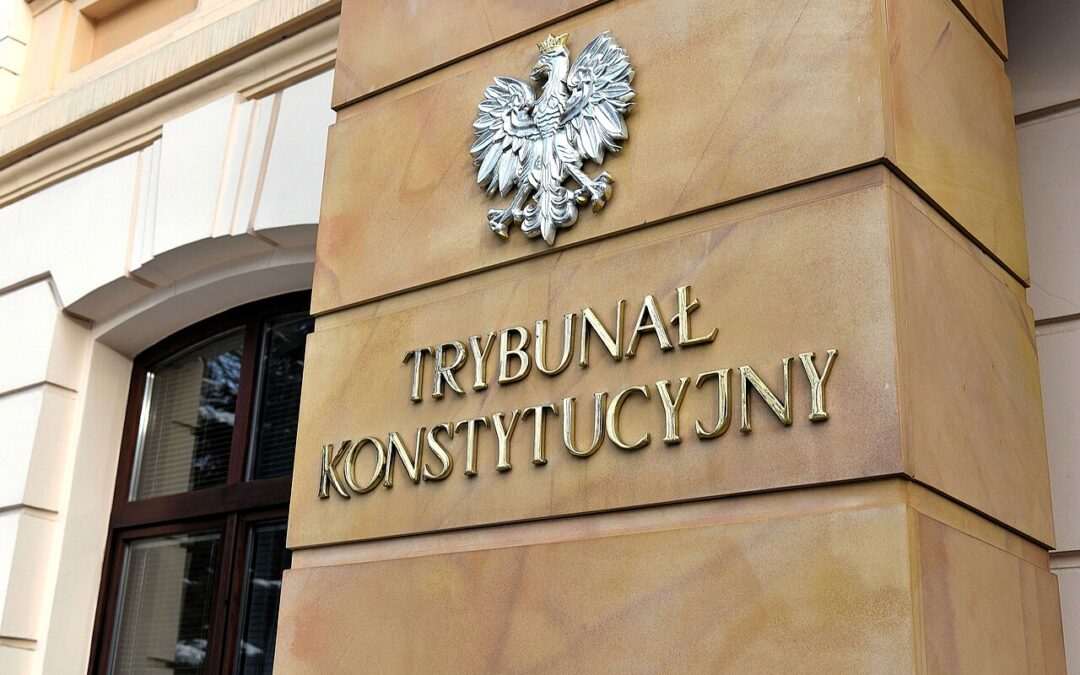
The government’s majority in parliament has chosen six judges to fill vacancies at the Constitutional Tribunal (TK), a body that is at the heart of Poland’s rule-of-law crisis.
For the judges to take office, however, they are meant to be sworn in by President Karol Nawrocki, who is aligned with the national-conservative opposition Law and Justice (PiS) party. That raises the prospect of a fresh standoff between the government and the head of state.
Sejm wybrał sześciu członków Trybunału Konstytucyjnego: Magdalenę Będkowską, Marcina Dziurdę, Annę Korwin-Piotrowską, Krystiana Markiewicza, Dariusza Szostka oraz Macieja Taborowskiego. pic.twitter.com/PrQlBabKOS
— Sejm RP🇵🇱 (@KancelariaSejmu) March 13, 2026
Since it replaced PiS in office in December 2023, the current government – a coalition ranging from left to centre right – has refused to recognise the TK or its rulings, due to the presence there of judges illegitimately appointed when PiS was in power.
It also notes that many of the TK’s judges, including the court’s supreme justice, Bogdan Święczkowski, have political connections to PiS, raising questions over their ability to adjudicate impartially. The TK is widely seen as being under PiS’s political influence.
The ruling coalition has even refused to allow the election of new judges to the TK by parliament when the terms of existing ones expire. As a result, only nine of the court’s 15 seats are currently occupied.
However, that situation changed this week, when the ruling coalition put forward six candidates to fill the TK vacancies and then voted them through in the Sejm, the more powerful lower house of parliament, on Friday afternoon.
The candidates are: Krystian Markiewicz, Maciej Taborowski, Marcin Dziurda, Anna Korwin-Piotrowska, Dariusz Szostek, and Magdalena Bentkowska.
The nominees, who would serve nine-year terms on the court, were supported mainly by MPs from the government’s majority, while PiS and the far-right Confederation, the other main opposition party, voted against them.
Before electing the judges, the Sejm also passed a resolution, again backed by the ruling majority, stating that it is necessary to take action to ensure that “the Constitutional Tribunal functions as a court established by law” and is “independent and impartial”.
Poland’s constitutional court has ruled that its own rulings should be regarded as being in force even though the government refuses to publish them because the court contains illegitimately appointed judges – a policy the court says is “legally unfounded” https://t.co/gBBz834eWj
— Notes from Poland 🇵🇱 (@notesfrompoland) September 24, 2025
However, under Polish law, judges appointed to the TK formally assume office only after taking an oath before the president. It appears possible that Nawrocki will refuse to take those oaths, as his PiS-aligned predecessor Andrzej Duda once did.
Although Polish law specifies what happens if a judge refuses to take the oath – treating it as a resignation from the post – it does not say what should happen if the president refuses to swear in judges, Jakub Jaraczewski, a rule-of-law expert at Democracy Reporting International, told Notes from Poland.
That is what happened in 2015, when Duda refused to swear in three judges legally chosen by parliament. Shortly afterwards, PiS then won parliamentary elections and nominated three replacements for those judges, who were sworn in by Duda.
Those three judges and their successors have been deemed illegitimate in a succession of rulings by Polish and European courts. It is their presence on the court that is the main reason the current government does not recognise its legitimacy.
The EU's top court has ruled that Poland's Constitutional Tribunal violated EU law when it rejected the primacy of EU law and the validity of EU court judgments
It also found that the tribunal isn't a valid court as it contains unlawfully appointed judges https://t.co/wOlRLh0iUP
— Notes from Poland 🇵🇱 (@notesfrompoland) December 18, 2025
Meanwhile, PiS is also seeking to prevent the swearing-in of the nominees. This week, it submitted a request for the TK to suspend the election of new judges while the tribunal assesses whether the regulations for nominating and electing new TK judges, which were originally introduced under PiS, are constitutional.
The case is scheduled for a hearing next week, on 17 March. According to the complaint, the president should refrain from administering the oath until the TK issues its ruling.
If Nawrocki refuses to swear in the judges elected today, Poland’s rule-of-law dispute will deepen further. Some legal experts have suggested alternative solutions for swearing in the judges that would bypass the president, but Jaraczewski underlines that “no such clear alternatives are provided in the law”.
Prawo i Sprawiedliwość złoży wniosek do Trybunału Konstytucyjnego o zabezpieczenie i czasowe wstrzymanie Sejmu od wyboru sędziów TK – poinformował poseł PiS @marcinwarchol.https://t.co/D90FCq7FuF
— Interia (@Int_Wydarzenia) March 9, 2026
Even if the ruling coalition resorts to such alternatives, the TK’s chief justice, Święczkowski, could still refuse to accept the new judges, potentially adding to the legal uncertainty surrounding the court.
“This, I believe, is the biggest practical challenge. We have scarcely any legal guidance on how the Polish authorities are to proceed,” says Jaraczewski.
Speaking to the media today, Nawrocki’s chief of staff, Zbigniew Bogucki, said that he did not know yet what the president will decide regarding the newly chosen TK judges. However, he said that “the law is clear: only the president can administer the oath to judges of the Constitutional Tribunal”.
Bogucki also criticised the current government for refusing to nominate new TK judges for two years, and only doing so now when it has the chance to choose a majority of the court’s bench (two further vacancies are due to open up later this year and another in January 2027).
Fifteen months since the change of government, Poland's rule-of-law crisis continues – indeed, many Poles think the situation has got worse.@J_Jaraczewski explains the roots of the crisis, what its impact has been, and how it might be resolved https://t.co/7KOCURV3dU
— Notes from Poland 🇵🇱 (@notesfrompoland) March 17, 2025
Notes from Poland is run by a small editorial team and published by an independent, non-profit foundation that is funded through donations from our readers. We cannot do what we do without your support.
Main image credit: Adrian Grycuk/Wikimedia Commons (under CC BY-SA 3.0 pl)

Alicja Ptak is deputy editor-in-chief of Notes from Poland and a multimedia journalist. She has written for Clean Energy Wire and The Times, and she hosts her own podcast, The Warsaw Wire, on Poland’s economy and energy sector. She previously worked for Reuters.