Keep our news free from ads and paywalls by making a donation to support our work!

Notes from Poland is run by a small editorial team and is published by an independent, non-profit foundation that is funded through donations from our readers. We cannot do what we do without your support.
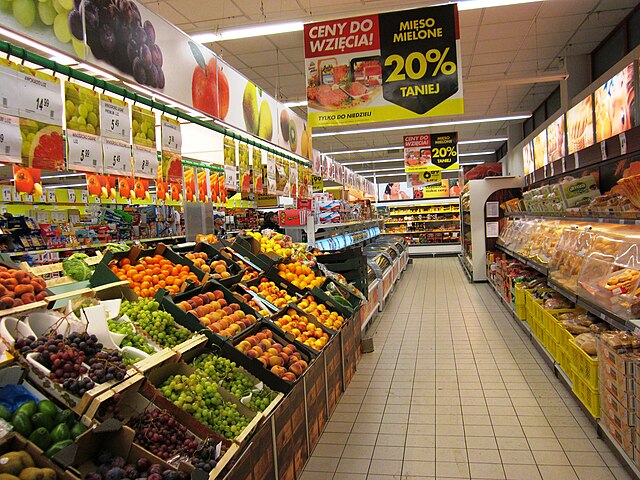
From this month, Poland’s government will require retailers to label loose fresh fruit and vegetables with national flags indicating their country of origin.
The measure, set to come into force on 17 February, is meant to improve transparency for consumers. But an industry body that represents supermarkets and grocery stores in Poland argues that it will significantly raise costs for retailers while potentially confusing customers and creating more environmental waste.
Planowany obowiązek oznaczania owoców i warzyw flagami krajów pochodzenia nie wnosi nowej wartości informacyjnej. Konsumenci już dziś mają dostęp do jasnych i czytelnych danych o pochodzeniu produktów, zgodnych z obowiązującymi przepisami.
Zachęcamy do zapoznania się z pełnym… pic.twitter.com/TQi1InYIUp
— Polska Organizacja Handlu i Dystrybucji (@POHiD_pl) January 30, 2026
Last November, the agricultural ministry adopted a regulation introducing the new rules. The government hopes they will encourage the purchase of local produce by helping consumers identify products originating from Poland more easily.
Under current EU regulations, retailers must already provide written country-of-origin information for unpackaged fruit and vegetables. In Poland, many homegrown products are also voluntarily marked with a “Produkt Polski” (Polish Product) logo that incorporates the flag and national colours.
However, the new rules will require retailers to label all loose fruit and vegetables with a national flag graphic, which must be “placed on a sign or in another place easily accessible to the buyer”.
“This is intended to provide consumers with clearer information about the country of origin of products – both verbally and graphically,” says the agriculture ministry.
🍎🥕 Nowe zasady znakowania żywności od 2026 r.
Już wkrótce na sklepowych półkach zobaczymy bardziej przejrzyste oznaczenia produktów!
Od 17 lutego 2026 r.:
🇪🇺 Świeże owoce, warzywa i banany sprzedawane luzem będą musiały mieć grafikę z flagą kraju pochodzenia.
To sposób na… pic.twitter.com/0ghtg8jV5D— Ministerstwo Rolnictwa i Rozwoju Wsi (@MRiRW_GOV_PL) November 28, 2025
But, in a statement issued last week, the Polish Organisation of Commerce and Distribution (POHiD), which represents leading retail chains operating in Poland, such as Biedronka, Carrefour, and Żabka, questioned whether the flag labels are necessary, and argued they may even be counterproductive.
“In the opinion of POHiD, this change will not only fail to enhance the recognition of Polish products, but may even depreciate the ‘Produkt Polski’ brand, visually equating it with products from any region of the world,” it explained.
The organisation also noted that some national flags are very similar to one another, making it hard to differentiate them on electronic displays and potentially confusing customers.
The industry body estimates that the new regulation would raise costs for a single large retailer operating in Poland by an average of about 17 million zloty (€4 million) a year.
“In practice, this [cost] includes modifying labelling systems, updating software and databases, changing central product management processes, and adapting labelling across a very large number of retail outlets,” the head of POHiD, Renata Juszkiewicz, told Notes from Poland.
POHiD also highlighted the potential negative environmental impact of the new regulation. “The additional printing of colored labels is contrary to environmental goals and the principle of sustainable development,” it said in a statement.
Under a new law, large Polish stores are now obliged to donate unsold food to NGOs, with failure to do so resulting in a fine.
Smaller shops will soon be required to do the same https://t.co/BsKXFkXgbK
— Notes from Poland 🇵🇱 (@notesfrompoland) March 2, 2020
Meanwhile, similar regulations for honey, juices and jams will come into force on 14 June. The agriculture ministry says that products made available on the market before the new sets of rules take effect may continue to be sold until existing stocks run out.
Poland was the EU’s third-largest producer of fruits, berries and nuts in 2024, behind Italy and Spain, and its fourth-largest producer of fresh vegetables, behind Spain, Italy and France, according to Eurostat.
Last November, the agriculture ministry recommended that the government buy the Polish assets of French supermarket giant Carrefour, which is looking to exit Poland.
They could then be used to create a state-owned grocery retail network that would help challenge the “dominance of foreign discount chains” and support Polish farmers and other producers, said the ministry.
The agriculture ministry has recommended that the government buy the Polish assets of French supermarket giant Carrefour and create a state grocery retail network that would challenge the “dominance of foreign discount chains” and support Polish farmers https://t.co/q68CgIkd7t
— Notes from Poland 🇵🇱 (@notesfrompoland) November 28, 2025
Notes from Poland is run by a small editorial team and published by an independent, non-profit foundation that is funded through donations from our readers. We cannot do what we do without your support.
Main image credit: Henryk Borawski/Wikimedia Commons (under CC BY-SA 3.0)

Olivier Sorgho is senior editor at Notes from Poland, covering politics, business and society. He previously worked for Reuters.



















_1.jpg)